
An AMO error log only works if it records why the mark was lost, not what the question was. Most notebooks are transcription exercises: question copied out, model solution copied underneath, nothing learned. A log that changes your score sorts every error into one of four causes, because each cause needs a different fix, and then re-tests you on the same problem weeks later.
This is the single highest-return habit in competition preparation, and it is also the one most students do badly. Below is the version we would hand a student on day one of a preparation block: what to write, how to classify it, when to come back, and how to read the finished log as data about where the next month should go.
Why most mistake notebooks change nothing
Ask a student to show you their mistake book and you will usually see one of three failure modes.
- The transcription book. Beautifully copied questions, beautifully copied model answers, in colour. It looks like work and feels like work. It is actually handwriting practice: the student has re-read someone else's reasoning, not rebuilt their own. Recognition is not recall.
- The everything book. Every wrong answer from every worksheet goes in, so the book grows to eighty entries and is never opened again. Volume kills review, and an entry that is never re-attempted has zero effect on any future paper.
- The label book. Every entry says "careless". This is the most damaging of the three, because "careless" is not a diagnosis — it is a way of avoiding one. Three completely different failures hide behind that word, and each needs a different remedy.
The fix is structural, not motivational. If the log forces you to name a cause from a fixed list, and forces you to re-attempt the problem later from blank paper, it stops being a scrapbook and starts being a training tool.
The four causes — and why each needs a different fix
Every lost mark on a maths competition paper falls into one of four buckets. Sorting matters because the remedies are not interchangeable: drilling arithmetic will never fix a comprehension problem, and re-reading a solution will never fix a pacing problem.
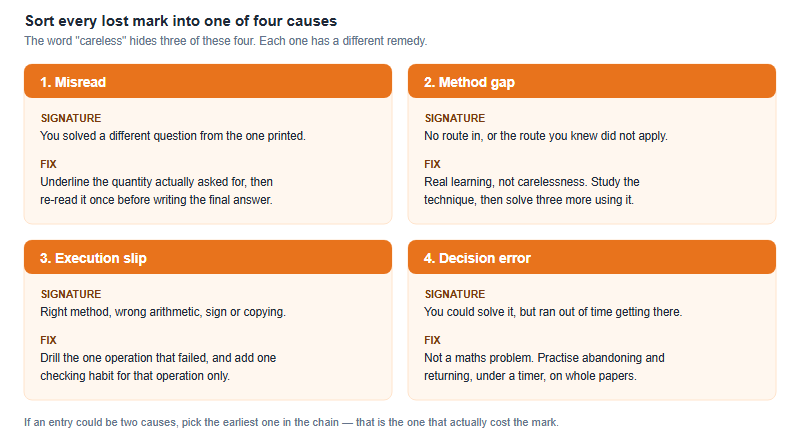
Two notes on classifying honestly. First, if an entry could belong to two causes, pick the earliest one in the chain. A student who misread the question and then also fumbled the arithmetic did not lose the mark to arithmetic — the misread had already lost it. Second, be suspicious of a log that is 90% "execution slip". That distribution is far more often a student protecting their self-image than an accurate diagnosis, and it is worth having someone else classify a few entries as a calibration check.
Running the log: five fields, then four visits
Keep entries short. A good entry takes about ninety seconds to write. If it takes ten minutes, the log will be abandoned within a fortnight — and an abandoned log is worth nothing.
| Field | What you write | Why it earns its place |
|---|---|---|
| 1. Source | Paper, year, level, question number, date attempted | Lets you re-attempt the original later without hunting, and lets you spot whether errors cluster in one paper section |
| 2. The slip, in one line | "Found the total, but the question asked for the difference" | Forces precision. If you cannot state the slip in one line, you have not finished diagnosing it |
| 3. Cause | One of: misread / method gap / execution slip / decision error | A fixed vocabulary makes the log countable. Free-text causes cannot be tallied at the end of the month |
| 4. The one-line fix | "Circle the word asking for the output before starting" | A fix you can perform on the next question. "Be more careful" is not a fix; it is a wish |
| 5. Re-test result | Dates and outcomes of later blank-page re-attempts | The only field that proves anything changed. Without it the log is a record of failures, not a record of repairs |
Notice what is not in the list: the full question text and the full model solution. Copying those is the habit that turns a log into a scrapbook. Keep a reference to where the question lives — our guide on what AMO is and how it is structured pairs naturally with a log kept against past-paper practice — and spend the saved time on re-attempts instead.
One housekeeping point while you set the log up: check which contest each logged paper belongs to. AMO is the contest run by SIMCC in Singapore with Southern Illinois University for grades 2 to 12; the AMC is a separate competition run by the Mathematical Association of America in the United States. They are different papers with different marking, so a log that mixes them will produce pacing and guessing conclusions that fit neither. Note the contest name in field 1 alongside the year and level.
Then comes the part that does the actual work: the review cycle. Re-attempting a problem the same evening tells you almost nothing, because the solution is still sitting in short-term memory. The value comes from spacing, and from re-attempting from a blank page rather than reading your own notes.
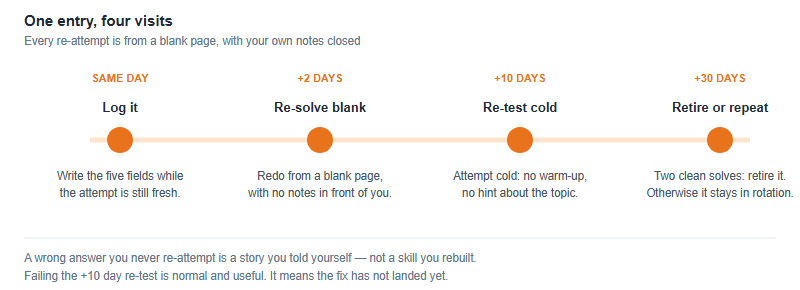
One rule protects the whole cycle: a re-attempt only counts if it is done from a blank page. Reading your own worked fix and nodding at it feels productive and produces no measurable change. If the blank-page attempt fails at day 10, that is not a setback — it is the log doing its job, and it tells you the fix in field 4 was too vague.
Reading the log as data at the end of the month
After four weeks, stop adding and start counting. Tally the entries by cause, and the distribution will point straight at the next month's plan.
- Mostly misreads. The problem is comprehension under time pressure, not mathematics. Practise reading the question aloud in the first pass and marking the target quantity before touching the numbers. For students working in a second language, this is by far the most common profile and the most fixable one.
- Mostly method gaps. Good news, in a sense: this is the one cause that responds directly to teaching. Group the gaps by topic, and if one topic owns more than a third of them, that topic is the whole of next month.
- Mostly execution slips. Identify the specific operation — not "arithmetic" but "subtracting across a zero" or "multiplying two negatives". Then drill only that, for ten minutes a day, and check whether the slip rate moves.
- Mostly decision errors. Stop doing single questions. This profile only improves on whole timed papers, where you have to make real ordering and abandonment decisions.
Keep one expectation calibrated while you do this. AMO awards are decided by percentile placement in the field rather than by a fixed mark, so a better log improves the part of your performance that you control — it does not entitle anyone to a band. Our explainer on how AMO scoring works sets out why comparing raw scores between years or levels is not meaningful, and how to read a result properly.
Four rules that keep the log alive
- Cap it. Five entries a week, maximum. A short log that gets reviewed beats a comprehensive one that gets abandoned, every time.
- Never log twice for the same reason. If the same fix appears in field 4 three times, the fix is not working. Change the fix rather than adding a fourth entry.
- Log the lucky ones. A question you guessed correctly is an unlogged gap. Mark it as a method gap and put it in the cycle like any other entry — on the day it matters, luck will not repeat.
- Keep it ugly. Pencil, one side of a page, no colours, no ruler. Every minute spent making the log beautiful is a minute not spent re-solving, and the log is not the deliverable. The rebuilt skill is.
Younger students can run a simplified version from around grade 4 — three fields instead of five, spoken aloud to a parent rather than written — and it still works, because the mechanism is the diagnosis and the re-attempt, not the paperwork. If you are deciding which level your child should be preparing for in the first place, start with our guide to AMO grade levels.
A final word on expectations. This method reliably converts marks you were already close to earning. It will not manufacture a medal, and no honest coach would promise one: AMO is run by SIMCC with Southern Illinois University, the papers are set by them, and the awards are ranked by percentile placement in the field. What a good error log gives you is the thing entirely within your control — fewer marks lost twice for the same reason.
Frequently asked questions
How many problems should go in an AMO error log?
Fewer than you think. Log only mistakes whose cause you can name, about five a week. Five well-diagnosed entries beat fifty copied ones.
Should I log a question I guessed correctly?
Yes. A lucky right answer is an unlogged gap. Record it as a method gap and re-test it cold like any other entry.
Is an error log useful for younger AMO students?
From about grade 4, in a simplified form: what I did, why it was wrong, one sentence to fix it. Keep it short and spoken aloud.
Does a better error log guarantee a higher AMO award?
No. AMO awards are set by percentile placement in the field, so no method guarantees a band. It improves what you control.
This site is operated by Hanlin Education as an authorized AMO registration partner for China. AMO (the American Mathematics Olympiad) is run by SIMCC together with Southern Illinois University — we are not the organiser, and we do not set papers or award medals. AMO is not the AMC, which is a separate contest run by the Mathematical Association of America in the United States. Format, marking rules, dates and award bands can change by season and by region; always confirm current details on the official SIMCC / AMO pages. We do not guarantee any result or admission outcome. Corrections are made within 7 working days.