
Number theory is the AMO strand that rewards preparation most reliably. Divisibility, remainder and digit questions appear from roughly Grade 5 upward, they take seconds to verify, and they are rarely guessable. Learn eight divisibility tests, one cycle idea and one place-value trick, and a stream of near-misses turns into marks. Here is the whole toolkit, band by band.
A quick orientation first. AMO, the American Mathematics Olympiad, is organised by SIMCC in Singapore together with Southern Illinois University (SIU), and it runs from Grade 2 to Grade 12 on a US Common Core framework. It is not the AMC, which is a separate contest run by the MAA in the United States with its own syllabus and pathway. If that distinction is new to you, start with our guide to what AMO actually is. Each level sits its own paper of 90 minutes, worked by hand without a calculator; confirm the current paper structure and rules for your sitting on the official SIMCC / AMO pages.
Why the number-theory strand pays more than its share
Students and parents tend to budget practice time in proportion to how much of the syllabus a topic occupies. For number theory that is the wrong instinct, for three reasons.
- The answers are checkable. A number-theory answer is a specific integer. Once you have a candidate, you can test it against the conditions in ten seconds. Almost no other strand offers that kind of self-marking.
- Attempt everything you can model. A half-cracked divisibility question is usually worth finishing, because the final check either confirms or kills the candidate in seconds. Marking schemes are set by the organiser and can differ by level and cycle, so confirm the marking rules for your sitting on the official SIMCC / AMO pages before deciding how freely to guess — see how AMO scoring works for the picture of medals and percentiles.
- The toolkit is finite. Geometry configurations are effectively unlimited. Divisibility is not. There are about eight tests worth knowing, one idea about remainders, and one idea about place value. That is a closed list a student can genuinely finish.
One honest caveat: the organiser does not publish a fixed topic weighting for each paper, and the balance shifts between levels and years. Treat everything below as a high-value strand, not as a guaranteed proportion of the paper, and confirm current guidance on the official AMO pages.
The four question families you will actually meet
Almost every number-theory question at AMO level belongs to one of four families. Recognising the family is most of the work, because each family has one dominant tool.
| Family | Usual band | The question sounds like | Tool that cracks it |
|---|---|---|---|
| Divisibility and factors | Grades 5–8 | “What is the smallest number divisible by both…” / “How many factors does…” | Divisibility tests, prime factorisation |
| Remainders and cycles | Grades 6–10 | “What is the remainder when…” / “What is the units digit of…” | Cycle length, remainder arithmetic |
| Digits and place value | Grades 5–9 | “A two-digit number is reversed…” / “the sum of its digits…” | Write the numeral as 10a + b |
| Primes, HCF and LCM | Grades 7–12 | “the smallest number that both… divide” / “buses leave every…” | Prime factorisation, HCF × LCM = product |
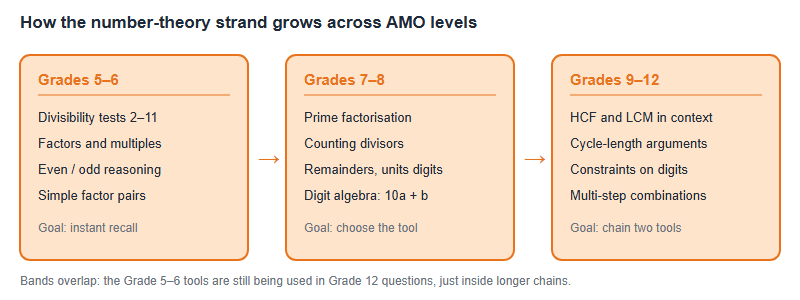
Note how the bands overlap rather than replace each other. A Grade 9 paper still asks divisibility questions; it simply wraps them in more steps. That is the general shape of AMO difficulty across levels, which we break down further in our explainer on AMO grade levels.
Divisibility and factors: the closed toolkit
This is the part a student can genuinely finish. Below are the eight tests worth automating, checked against a single number so you can see them working together: 5,148.
| Divisor | Test | Applied to 5,148 | Why it works |
|---|---|---|---|
| 2 | Last digit is even | 8 → yes | 10 is even, so only the units digit matters |
| 3 | Digit sum divisible by 3 | 5+1+4+8 = 18 → yes | Every power of 10 leaves remainder 1 |
| 4 | Last two digits divisible by 4 | 48 → yes | 100 is a multiple of 4, so the head is irrelevant |
| 5 | Last digit 0 or 5 | 8 → no | 10 is a multiple of 5 |
| 6 | Passes both 2 and 3 | yes and yes → yes | 2 and 3 share no common factor |
| 8 | Last three digits divisible by 8 | 148 is not → no | 1,000 is a multiple of 8 |
| 9 | Digit sum divisible by 9 | 18 → yes | Same reason as the test for 3 |
| 11 | Alternating digit sum divisible by 11 | 8 − 4 + 1 − 5 = 0 → yes | Powers of 10 alternate between remainder 1 and −1 |
Two things students almost never get taught. First, there is no test for 7 worth memorising — the shortcuts are slower than dividing. Second, the tests are most powerful when used to build a prime factorisation rather than to answer a yes/no question. Running the tests on 5,148 gives 2² × 3² × 11 × 13 in under a minute, and that factorisation answers a whole class of follow-up questions at once. The number of factors, for example, comes from adding one to each exponent and multiplying: (2+1)(2+1)(1+1)(1+1) = 36 factors. Students who memorise “count the factors by listing them in pairs” lose a minute per question here; students who factorise first lose none.
Remainders, cycles and digit algebra
The single most transferable idea in this strand is that only the remainder matters, and remainders repeat. You do not need the word “modulo” to use it, and at AMO level the plain remainder language is enough.
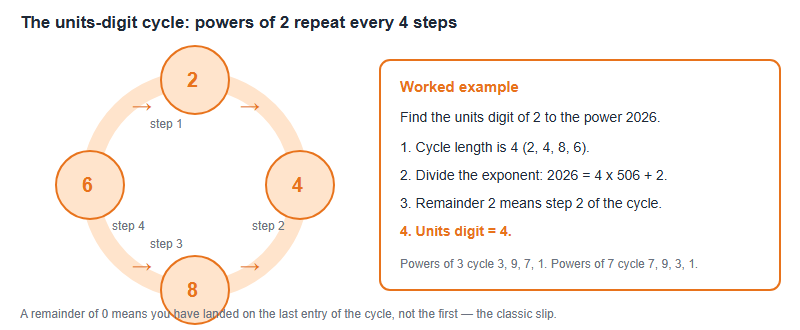
Start with the units digit of a power. The final digit of 2, 4, 8, 16, 32, 64… runs 2, 4, 8, 6 and then repeats forever — a cycle of length four. So the units digit of 2 raised to the power 2026 is found by dividing the exponent by the cycle length: 2026 = 4 × 506 + 2, so we are two steps into the cycle, and the answer is 4. The same reasoning gives 3, 9, 7, 1 for powers of 3 and 7, 9, 3, 1 for powers of 7. Two cycles, four lines of work, an entire question type solved.
The same idea handles calendar questions (100 days after a Monday is 100 = 7 × 14 + 2, so a Wednesday) and remainder questions about big numbers, because remainders can be combined before you multiply or add. The remainder of 2,026 on division by 9 is just the digit sum reduced: 2 + 0 + 2 + 6 = 10, and then 1 + 0 = 1.
Digit problems yield to one move: stop treating the numeral as a picture and write it as algebra. A two-digit number is 10a + b, where a runs from 1 to 9 and b from 0 to 9. Once written that way, the classic results fall out immediately. Reverse the digits and subtract: (10a + b) − (10b + a) = 9(a − b), which is why the difference is always a multiple of 9. Add instead of subtracting and you get 11(a + b), always a multiple of 11. A question such as “a two-digit number equals four times the sum of its digits” becomes 10a + b = 4(a + b), so 6a = 3b, so b = 2a — giving 12, 24, 36 and 48, found in one line rather than by trial. The same substitution extends upward: four-digit palindromes are always divisible by 11, which a student can prove in a line with the alternating-sum test.
A four-week training block that moves the score
This strand responds to short, frequent, deliberate practice far better than to long weekend sessions. Ten to fifteen focused minutes a day beats two hours on a Sunday, because the goal for half of the toolkit is automaticity, not understanding.
- Week 1 — recall. Ten minutes a day. Take twenty random four-digit numbers and run all eight tests on each. By day five the student should be answering without re-reading the rule. This is drilling, and it should feel like drilling.
- Week 2 — structure. Prime-factorise ten numbers a day, then count their factors from the exponents. Add HCF and LCM questions in context: repeating bus timetables, tiles fitting a floor, gears meshing.
- Week 3 — remainders. Units digits of powers, calendar problems, and remainder-of-a-big-number questions. Insist on the two-line format: cycle length, then exponent divided by cycle length.
- Week 4 — mixed and timed. Twelve questions drawn from all four families, unlabelled, in twenty-five minutes. The skill being trained here is family recognition, which is the one thing weeks 1 to 3 cannot teach.
One habit is worth more than any of the drills: after every solved question, the student writes a single line saying which tool solved it. In the practice sets our tutors mark, the students who plateau are almost never the ones who lack the rules; they are the ones who cannot tell within ten seconds which of the four families they are looking at. Naming the tool out loud, every time, is what fixes that. Sourcing four weeks of problems is the practical obstacle for most families: our preparation guide sets out the practice habits and English maths vocabulary we start students on, and you can ask us there for recommendations matched to your child’s grade.
On timing: SIU has published a 2026 AMO testing window running from mid-October to mid-November, with registration required a stated period before the chosen test date, and lists its own sittings as paper-based. Format, dates, fees and deadlines all differ by country and by registration route — some regional routes run online sittings — so confirm your own sitting on the official SIMCC / AMO pages before you count backwards. From late July, however, there is comfortable room for two four-week blocks with a break between them.
Frequently asked questions
Does my child need to know the word “modulo” for AMO?
No. Plain remainder language carries the whole strand at these levels. The idea matters, not the notation. Confirm scope on the official AMO pages.
Is there a quick divisibility test for 7?
Several exist, but none is faster than simply dividing. Better to prime-factorise the number first, which usually answers the question anyway.
How much of an AMO paper is number theory?
It varies by level and year, and the organiser does not publish fixed topic weightings. Treat it as high-value, not a guaranteed share.
Is this the same material as the AMC?
No. AMO is run by SIMCC with SIU for Grades 2 to 12; the AMC is a separate MAA contest in the USA with its own syllabus and progression.
This site is an independent English-language guide for families preparing for AMO, operated by Hanlin Education. The American Mathematics Olympiad is organised by SIMCC (Singapore International Mastery Contests Centre) together with Southern Illinois University (SIU); we are not the official AMO or SIMCC organiser, we are not affiliated with them, and we do not set the rules. Formats, dates, fees, syllabus scope and award thresholds are decided by the organiser and change from cycle to cycle — for official registration, rules, dates and fees, always refer to the official organiser and confirm details on the official SIMCC / AMO pages. Factual errors are corrected within 7 working days of notice.