
Is AMO hard? The honest answer is “it depends on the grade and the question.” Within any single paper, problems build from accessible to genuinely challenging, and difficulty rises steadily as you move up the grade bands. What changes the whole picture, though, is that AMO is percentile-ranked rather than scored against a fixed pass mark — so “hard” means “hard relative to a strong international field,” not “hard to pass.” AMO is run by SIMCC of Singapore for grades 2 to 12, and it is not the US AMC.
Why “how hard is AMO?” is the wrong question on its own
Parents usually ask whether AMO is hard as if there were one answer. There is not, and the design is the reason. AMO — the American Mathematics Olympiad, organised by the Singapore International Mathematical Contest Centre (SIMCC) with Southern Illinois University (SIU) — sorts students by percentile. Your award reflects where you finish in the field, not whether you cleared a set line. If you are new to how this works, our overview of what AMO is lays out the basics.
That single fact reframes difficulty. A paper can contain problems a child finds very hard while the child still earns a good award, because plenty of other capable students found those same problems hard too. So the useful question is not “will this be hard?” (some of it will) but “hard compared with whom, and what is a realistic finish for my grade?” The rest of this guide answers that honestly.
It is worth separating two very different meanings of “hard” that families tend to blur. One is emotional difficulty — does the paper feel intimidating, does my child come out discouraged? The other is statistical difficulty — where does their score actually land in the field? A paper can feel brutal and still produce a strong result, or feel comfortable and land mid-pack. Judging AMO by the feeling alone is misleading; the percentile is the honest measure, and it is often kinder than the exam-room nerves suggest.
Difficulty inside a single paper
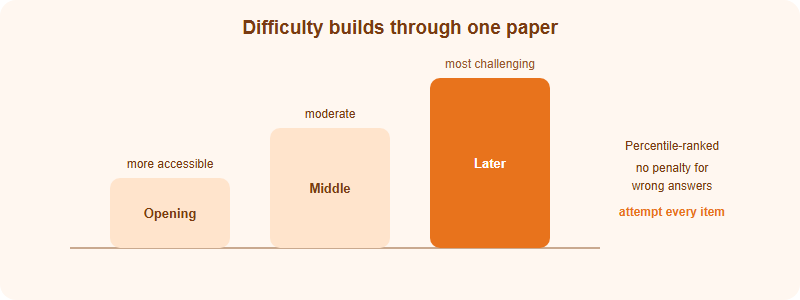
Whatever the grade, an AMO paper is built to reward reading carefully and pacing yourself. The opening problems are more accessible and meant to be attempted by most participants; the later problems demand multi-step reasoning and are designed to separate the field. Our breakdown of the AMO scoring system explains two features that matter enormously for how “hard” the paper feels in practice.
- No penalty for wrong answers (in recent years): a guess costs you nothing, so leaving blanks is rarely wise. Attempt everything.
- Percentile-based medals: you are measured against peers, so you do not need a perfect score to earn a strong award.
We are not printing a fixed number of questions or the exact section mark split, because the official format varies year to year — confirm the current structure on the official AMO pages. The shape, however, is consistent: warm up on the early items, spend your time where the marks are, and never freeze on a hard problem when there is no downside to trying.
There is a subtler point about time. Because the later problems are meant to be hard and there is no reward for perfectionism on any single item, spending fifteen minutes forcing one stubborn question is usually a poor trade — those minutes buy more marks spread across several accessible questions elsewhere. Strong AMO performers are rarely the fastest calculators; they are the students who spend their limited time well, know when to move on, and return to the hard items only once the dependable marks are banked.
How the challenge scales by grade band
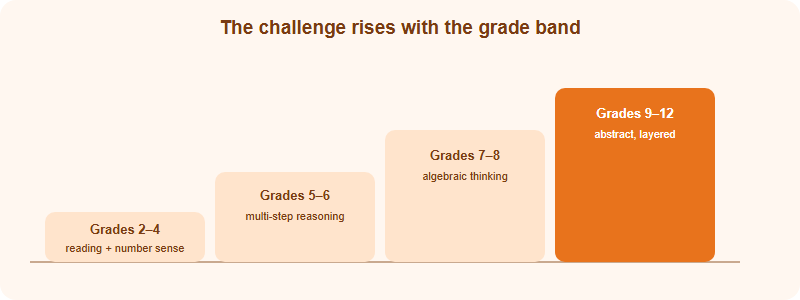
The bigger driver of difficulty is the grade band itself. Each level sits its own paper, so a younger student is never thrown in with older students — but the mathematics genuinely deepens as you climb. The picture below is qualitative, not an official specification; treat it as a rough map and check your child's exact division in our AMO grade-levels guide.
| Grade band | What makes it hard at this level | What “doing well” tends to require |
|---|---|---|
| Grades 2–4 | Careful reading of English word problems; not rushing | Secure arithmetic and number sense, calmly applied |
| Grades 5–6 | Multi-step problems that combine several ideas | Fluent operations plus early logical reasoning |
| Grades 7–8 | Algebraic thinking and less obvious problem set-ups | Comfort with variables, ratios and structured working |
| Grades 9–12 | Abstract, layered problems that reward insight | Flexible reasoning and confident timed problem-solving |
Notice what is not in that table: fixed cut-off scores, exact question numbers, or a promise that a given grade is “easy” or “impossible.” Those specifics are set officially and shift year to year. The durable truth is that difficulty scales with the grade band, so a student who found a lower level comfortable should expect the next one to ask more.
There is one more honest nuance. “Harder” at a higher grade does not only mean bigger numbers or longer questions; it means the problems reward genuine insight over routine. A lower-primary problem might yield to careful, methodical work, while a senior problem can hinge on spotting a clever way in that no amount of grinding will reveal. That shift — from “can you compute it?” to “can you see it?” — is what most surprises students moving up the ladder, and it is why the early habit of genuinely exploring problems, rather than only drilling procedures, pays off so much later.
Setting a realistic target (without chasing a perfect score)
Because AMO is percentile-ranked, a healthy target is a position, not a flawless paper. In recent years the medal tiers have run roughly Gold for about the top 8%, Silver the next 12%, and Bronze the next 20% — so a little under half the field earns a medal — but the exact cut-offs change every year, so confirm the current thresholds on the official AMO pages. The practical implication is liberating: your child does not need to solve everything to do well; they need to solve steadily and finish.
A sensible way to set expectations by readiness:
- First-time entrant: aim to attempt every question and finish calmly. A participation experience with no blanks is a genuine win.
- Returning student: target a higher percentile band than last year, driven by fewer careless errors rather than raw speed.
- Confident student: aim for the upper medal tiers, knowing the last few problems are meant to be hard and may stay unsolved.
A short worked example makes this concrete. Picture a returning grade 7 student who earned a Bronze last year. A weak target is “get everything right”, which invites panic on the hard problems. A strong target is “cut my careless errors in half and finish the paper”, which is fully within their control — and in a percentile field, that is exactly the kind of improvement that lifts a Bronze toward a Silver. Targets you can act on always beat targets you can only wish for.
Is AMO too hard — or too easy? Two honest checks
Some families worry AMO will crush a young child; others worry it will bore a strong teenager. Both worries usually dissolve with a simple test: sit one official-style paper at the right level, untimed at first, and watch what happens. If the child can access the opening problems and enjoys wrestling with a couple of the harder ones, the level is right — the difficulty is a feature, not a wall.
If almost every problem is inaccessible, the level (or the timing) is too ambitious for now, and there is no harm in waiting; the grades 2 to 12 span leaves plenty of runway. If every problem falls instantly and the later ones offer no challenge, the student may be ready to move up a division. Difficulty, in other words, is information — it tells you whether the level fits, not whether your child is “good at maths.”
This is also why comparing your child to a classmate is rarely useful. Two students can sit the same level, find completely different problems hard, and both come away with a strong percentile, because the field is broad and international. The only comparison that reliably drives progress is your child measured against their own last attempt.
Frequently asked questions
Is AMO hard?
It varies by grade and by question. Papers build from accessible to challenging, and you are ranked by percentile, not against a fixed pass mark.
Is there a penalty for wrong answers in AMO?
In recent years, no — which is why attempting every question is sensible. Confirm the current rules on the official AMO pages.
What score do I need for a medal?
Medals are percentile-based (recent years: roughly top 8% Gold, 12% Silver, 20% Bronze). Confirm current cut-offs officially; see our scoring guide.
Does AMO get harder each grade?
Broadly yes — the challenge scales with the grade band, and each level sits its own paper. See the grade-levels guide.
This guide is published by AMO Club, operated by Hanlin Education as an authorized AMO registration partner for China. AMO is run by SIMCC (Singapore) and Southern Illinois University (SIU); we are not the organiser. Competition details — format, difficulty, awards and cut-offs — can change, so always confirm on the official SIMCC / AMO pages. Spotted an error? We correct verified mistakes within 7 working days.