
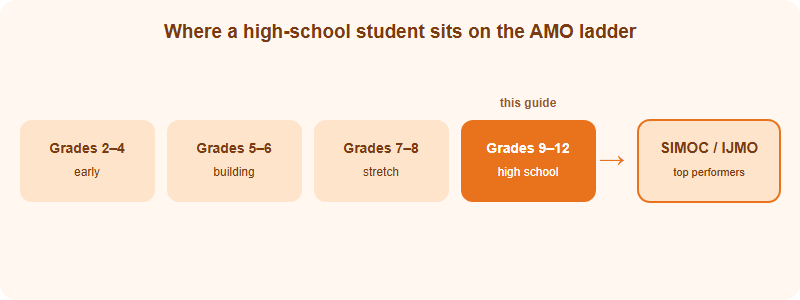
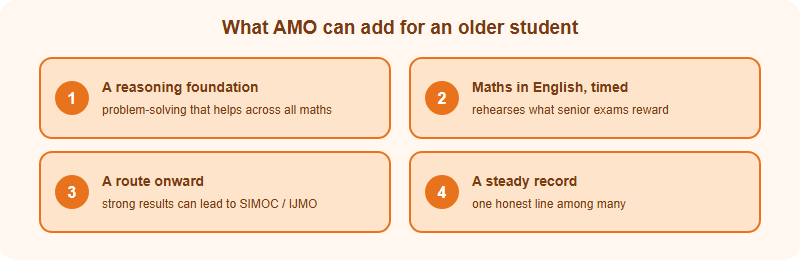
Yes — because AMO runs all the way through grade 12, high-school students can and do take part. But the better question is not “am I allowed?” It is “what will a senior AMO paper actually give me, and how should I prepare differently from a ten-year-old?” AMO is organised by SIMCC of Singapore for grades 2 to 12 (it is not the US AMC), and for older students it works best as a foundation and a stepping stone — not as a finish line.
Can high-school students really do AMO?
They can. AMO — the American Mathematics Olympiad — is run by the Singapore International Mathematical Contest Centre (SIMCC) together with Southern Illinois University (SIU), and it is open across the full span of grades 2 to 12. That upper reach into the senior years is easy to miss, because AMO is best known as an early, encouraging competition for primary and middle school. If AMO is new to you, start with our overview of what AMO is, then come back here for the high-school angle.
One point deserves repeating before anything else, because it causes real confusion for older students in particular: AMO is not the AMC. The AMC (American Mathematics Competitions) is a separate series run by the Mathematical Association of America in the United States, aimed mainly at high schoolers and feeding into the US olympiad track. AMO belongs to a different family entirely, based in Singapore. A grade 11 student can pursue either, both, or neither — but they should never assume the two names mean the same event.
What a senior AMO paper asks of you
At the senior end, AMO stops being a gentle introduction and becomes a genuine reasoning test. Two design features shape the experience. First, AMO is percentile-ranked: awards reflect where you land in a strong international field rather than whether you clear a fixed pass mark. Second, in recent years there has been no penalty for wrong answers, which rewards students who attempt everything rather than freezing on the hard items. You can read the mechanics in our guide to how AMO scoring works.
On difficulty, be realistic. Within a single paper the problems build from accessible to genuinely challenging, and a strong grade 11 student will still meet questions that demand real thought, not just recall. We are deliberately not printing a fixed question count or the exact section split here, because the official format varies from year to year — confirm the current structure for your grade on the official AMO pages before you plan. What is stable is the character of the exam: timed, English-medium, and rewarding students who reason clearly under pressure.
A useful way to approach a senior paper is in three passes. On the first pass, move quickly and bank every problem you can solve confidently, skipping anything that does not resolve within a minute or two. On the second pass, return to those skipped problems with fresh eyes and more time, now that the reliable marks are secured. On the final pass, with whatever minutes remain, make a genuine attempt at everything still blank — if the current rules carry no negative marking (confirm this officially), a considered guess on a hard problem carries little downside. This discipline matters most at the senior end, where the gap between finishing and not finishing often decides a whole percentile band.
Who AMO suits at high-school age
AMO is not automatically the right competition for every senior student, and it is more honest to say so. It tends to be a strong fit for some readers and a lower priority for others.
| AMO is a good fit if you are… | You may prioritise other routes if you are… |
|---|---|
| Building a solid, broad problem-solving foundation | Already deep into a specialised olympiad track and short on time |
| Newer to competition maths and want an encouraging, percentile-ranked field | Specifically targeting a national or US olympiad pathway (a different family of contests) |
| Strengthening the skill of reading and solving maths in English under time | Looking only for the single hardest possible contest as a headline credential |
| Interested in the SIMCC progression toward SIMOC and IJMO | In your final application months with no room for anything new |
In our experience coaching international-school students, the seniors who get the most from AMO are usually the ones treating it as training and a confidence marker, not as a trophy hunt. If your reason for entering is “it will look impressive,” pause and think again; if your reason is “it will sharpen how I reason and give me a clear target,” you are on firmer ground.
How senior prep differs from younger years
A ten-year-old and a sixteen-year-old should not prepare the same way. Younger AMO prep is deliberately light, playful and short. Senior prep can be more deliberate, more time-pressured and more self-directed — but it should still be efficient, because high schoolers rarely have spare hours. The shift looks like this.
| Dimension | Younger students (primary / lower-middle) | Senior students (grades 9–12) |
|---|---|---|
| Session length | Short, frequent, playful | Focused blocks, driven by an error log |
| Main goal | Enjoyment and steady exposure | Efficient coverage of gaps and timed accuracy |
| Practice material | Official-style problems, gentle pace | Full timed papers, then targeted review of weak topics |
| Independence | Guided by a parent or coach | Largely self-run; owns their own review cycle |
| Language work | Learning core maths vocabulary | Reading dense word problems fast and accurately |
A practical senior routine is simple: sit a timed set, mark it honestly, and keep a running log of the specific ideas that cost you marks — a factoring shortcut you missed, a geometry configuration you did not recognise, a word problem you misread. Because AMO awards are percentile-based and there is no wrong-answer penalty, the highest-value habit is finishing the paper and attempting every question, then closing gaps between attempts. To calibrate which division you are actually sitting, check the AMO grade levels and confirm the exact boundary on the official pages.
A concrete illustration helps. A grade 10 student with three free evening slots a week might spend one on a fresh timed section, one reviewing the errors from it, and one on a topic they keep getting wrong — say counting problems or number theory. Three focused half-hours tied to real feedback will do more than a vague hour of “doing maths” every night. The senior advantage is not more time; it is the maturity to run that feedback loop without being chased through it by a parent.
Making AMO count — without overpromising
Two honest notes to close on. First, on progression: the SIMCC family is built so that strong AMO performers can advance toward SIMOC and IJMO. That is a real reason for an ambitious senior to enter, but the exact qualifying criteria are set year by year, so confirm them on the official AMO and SIMCC pages rather than assuming a fixed rule.
Second, on university applications: an AMO result can be one truthful line in a wider record, but no competition — AMO or any other — guarantees admission, and nobody can sell you a certain outcome. Anyone who promises one is not describing this competition honestly. Present what you actually achieved, in plain terms, and let it sit alongside the rest of your work. For a high schooler with the time and the curiosity, that is a perfectly worthwhile place for AMO to land.
One last practical note for older students: fit AMO around your existing commitments rather than bolting on hours you do not have. A realistic senior investment is a short weekly problem set during term, ramping to one or two full timed papers in the weeks before you sit. That is usually enough to arrive sharp without cannibalising the schoolwork, sport or research that also matters. If a season is genuinely too full, it is wiser to skip a year than to prepare badly — AMO will still be there next year, and a half-hearted attempt teaches very little.
Frequently asked questions
Can a grade 11 or 12 student take part in AMO?
Yes. AMO runs through grade 12, so senior students sit their own division. Confirm your exact division on the official AMO pages.
Is AMO the same as the AMC for high schoolers?
No. AMO is a SIMCC contest from Singapore for grades 2 to 12; the AMC is a separate US MAA contest. They are different competitions.
Is AMO too easy for a strong high-school student?
Senior papers include genuinely challenging problems, and percentile ranking measures you against peers. Difficulty varies by question; confirm the format officially.
Will AMO help my university application?
It can be one honest line among many, but no competition guarantees admission. Always present any result truthfully.
This guide is published by AMO Club, operated by Hanlin Education as an authorized AMO registration partner for China. AMO is run by SIMCC (Singapore) and Southern Illinois University (SIU); we are not the organiser. Competition details — format, eligibility, awards and progression — can change, so always confirm on the official SIMCC / AMO pages. Spotted an error? We correct verified mistakes within 7 working days.