
Running the AMO (American Mathematics Olympiad, organised by SIMCC of Singapore and SIU) at your school comes down to four jobs: appointing a coordinator, planning a registration and communication timeline, administering the paper under the official rules, and turning results into momentum for your math programme. This guide walks a teacher or coordinator at an international school through all four — including the parent questions you will definitely be asked, and how to answer them accurately.
Why schools offer AMO — and what it asks of you
For an international school, AMO occupies a genuinely useful niche. It spans Grades 2–12, so one competition can serve a whole school rather than only a high-school elite; its content aligns with the US Common Core progression, so it complements rather than contradicts most international curricula; and its awards structure recognises a meaningful share of entrants, which makes it workable as a participation event for a year group, not just a trophy hunt for the top three students. (For the full picture of divisions and what each assumes, see our guide to AMO grade levels from Grade 2 to Grade 12.)
What it asks of the school is modest but real: one named adult who owns the process. In our experience supporting schools across China as an authorized registration partner, the single biggest predictor of a smooth AMO season is not school size or math-department strength — it is whether one person holds the checklist from start to finish. Schools where registration, parent communication and exam-day logistics are split across three people with no owner are the schools where deadlines get missed.
One framing decision to make early: is AMO at your school an open-invitation enrichment event, a math-club activity, or a selected-team entry? All three models work. Open invitation maximises participation and tends to surface unexpected talent in the middle grades; the selected-team model suits schools that already run a busy competition calendar. Decide before you communicate anything to parents, because the framing changes every message you send.
The coordinator’s year: four phases
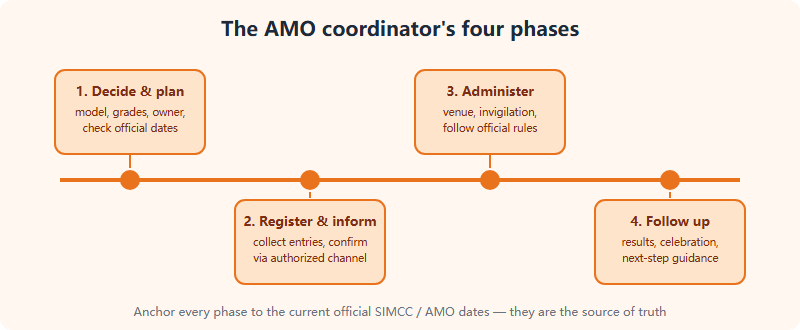
Here is each phase as a working checklist. Deliberately, there are no hard dates in this table: AMO’s registration windows and exam dates are set by the organiser and change from season to season, so step one of every phase is “check the current official SIMCC / AMO pages” (or ask your registration partner to confirm them for you).
| Phase | Core tasks | Common failure to avoid |
|---|---|---|
| 1. Decide & plan | Choose participation model; confirm which grade levels you will offer; name the coordinator; verify this season’s registration deadline and exam window on the official pages; get calendar sign-off from school leadership | Assuming last year’s dates still apply |
| 2. Register & inform | Send the parent letter (see below); collect student entries and correct grade-level assignments; submit registrations through the official channel or an authorized registration partner; confirm every student received confirmation; pass any fee information to parents exactly as published officially | Late or incomplete student lists; guessing at fees instead of quoting the official figure |
| 3. Administer | Book a quiet venue; brief invigilators on the official rules for materials, timing and conduct; prepare seating by division; run the session exactly per the organiser’s instructions for that season | Improvising rules (calculators, timing) instead of following the official instructions issued for that sitting |
| 4. Follow up | Distribute results and certificates when released; celebrate all award tiers, not only gold; run a short debrief with students; advise interested families on next steps, including possible invitational rounds | Letting results land in silence — the follow-up window is where a math culture is actually built |
The parent letter: five questions to answer before they ask
Every coordinator ends up fielding the same parent questions. A one-page letter that answers all five in advance will save you a week of emails:
- “Is this the AMC?” No — and say so explicitly. AMO is the American Mathematics Olympiad, organised by SIMCC together with Southern Illinois University; it runs from Grade 2 to Grade 12. The AMC (American Mathematics Competitions) is a different programme run by the Mathematical Association of America in the USA. The similar names cause genuine confusion every season, and a coordinator who clarifies this up front earns instant credibility. Our explainer What Is AMO — A Parent’s Guide covers the distinction in depth if you want a link to include.
- “Which level will my child sit?” Explain that AMO is divided by grade level across Grades 2–12 and that students sit the division matching their grade. Link the grade-levels guide above for detail.
- “How is it scored, and can my child ‘fail’?” Reassure: awards are given by performance bands — gold, silver and bronze medal tiers reaching a substantial share of participants — and there is no penalty scoring for wrong answers. Every participant receives recognition of participation. Our scoring guide is a parent-friendly reference; the authoritative current rules live on the official pages.
- “What does it cost and how do we pay?” Quote only the officially published fee for the current season, via whichever registration route your school uses. Never estimate from memory or from a previous year.
- “What happens if they do well?” Strong performers may be invited to further SIMCC competitions such as SIMOC and IJMO; frame this as an option, not an obligation, and point families to the official information for eligibility details.
Exam-day logistics that actually go wrong
Exam administration is mostly common sense, but four specific failure points recur in schools’ first seasons:
Division mix-ups. With up to eleven grade levels potentially sitting in one room, the highest-risk moment is paper distribution. Seat students by division, label desks in advance, and have invigilators verify name, grade and paper level for every student before the start signal — not during collection, when it is too late.
Improvised rules. Whether calculators or other aids are permitted, exact timing, and conduct rules are all defined by the organiser’s official instructions for that sitting. Do not carry over assumptions from other competitions your school runs, and do not rely on a colleague’s memory of a previous year. Print the current official instructions and brief every invigilator from that document alone.
Timing drift. Assign one invigilator as the official timekeeper with a single visible clock. Write start and end times on the board. Younger divisions especially need a mid-session time reminder delivered calmly, not a surprise five-minute warning.
No contingency owner. A student arrives late; a student feels unwell; a fire drill is scheduled at the wrong moment. None of these are disasters if the coordinator has decided in advance who handles each and what the organiser’s guidance says about disruptions. Ask your registration partner or the organiser before exam day what the correct procedure is for interrupted sittings — do not invent one under pressure.
After results: turning one exam into a programme
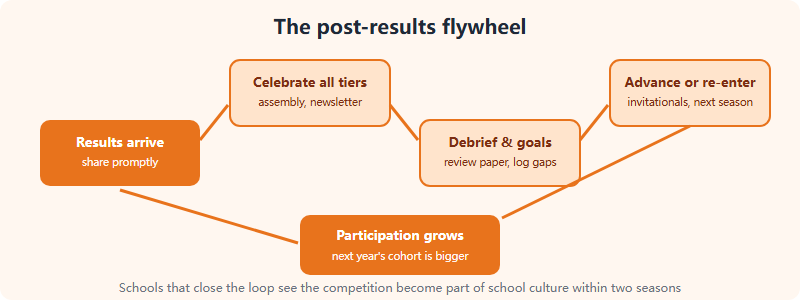
The fortnight after results are released is worth more to your math culture than the exam itself. Three practices we consistently see work in schools:
- Celebrate breadth, not just the top. Because AMO’s medal structure reaches well beyond a handful of winners, you can honour a genuinely large group. Read bronze names with the same energy as gold; the Grade 4 student who medals this year is your Grade 8 team captain in four years.
- Run a 40-minute debrief. Reconvene participants, walk through two or three problems that rewarded interesting thinking, and let students present their approaches. This converts a solitary exam into a shared intellectual event — and quietly recruits next year’s cohort from the students who watched.
- Give high performers a named next step. Eligible strong performers may receive invitations toward SIMCC’s follow-on events such as SIMOC and IJMO; make sure those families know where to find the official details, and connect them with whoever manages your school’s registrations so the opportunity is not lost to a missed email.
Finally, log everything: entry numbers by grade, communication dates, what confused parents, what went wrong on the day. A one-page season retrospective turns your successor’s first year into a repeat performance instead of a rediscovery — and it is the document that persuades school leadership to keep the competition on the calendar.
FAQ
Does a school need a minimum number of students to offer AMO?
Entry requirements and any minimums are set by the organiser and can vary by season and region, so confirm the current conditions on the official SIMCC / AMO pages or with an authorized registration partner before you plan.
Can students at our school register individually instead of through the school?
Available registration routes depend on the current season’s official arrangements. Many families in China register through authorized partners; coordinators should confirm which routes apply to their situation officially.
Which teachers should invigilate — do they need math backgrounds?
No special math background is needed to invigilate. What matters is briefing every invigilator from the current official instructions on timing, permitted materials and conduct, rather than from memory of other competitions.
Is AMO the same as the American AMC our high-schoolers take?
No. AMO is organised by SIMCC of Singapore with SIU and spans Grades 2–12; the AMC is run by the MAA in the USA. They are separate competitions with separate registrations, formats and pathways.
This site is operated by Hanlin Education as an authorized AMO registration partner for China. The AMO (American Mathematics Olympiad) is run by SIMCC and SIU; we are not the organiser. Competition formats, dates, fees and rules should always be confirmed on the official SIMCC / AMO pages. If you spot an error in this article, we will correct it within 7 working days.