
Most marks lost at the AMO (American Mathematics Olympiad, run by SIMCC of Singapore and SIU) are not lost to problems a student could never solve. They are lost to five repeatable mistake families: misreading the question, arithmetic slips, time traps, answer-recording errors, and abandoning problems too early. Each family has a different root cause — and a different fix. This guide shows you how to diagnose which family costs you the most marks, and gives a concrete repair routine for each.
Why “careless mistakes” is a useless diagnosis
When a student reviews a practice paper and says “that was just a careless mistake,” the review is over — and nothing improves. In our coaching work with international-school students preparing for AMO, we ask families to ban that phrase entirely. Every wrong answer on a solvable problem has a mechanical cause: an eye skipped a word, a mental calculation overloaded working memory, a clock forced a guess, or a correct result was copied wrongly. Mechanical causes can be trained away. Vague “carelessness” cannot.
This matters more at AMO than at many school exams because of how the competition is scored. As explained in our guide to how AMO scoring works, there is no penalty for wrong answers under the published scoring guidance (confirm current rules on the official SIMCC / AMO pages), and medals are awarded by percentile bands. Near the medal boundaries, a single recovered mistake can move a student across a band. In other words: for most students, fixing mistakes is a faster route to a better result than learning new topics.
One caveat before we begin: AMO paper structure and question formats can vary by year and level, so always confirm the current format on the official SIMCC / AMO pages rather than assuming last year’s paper is a template. The mistake families below are format-independent — they show up whatever the paper looks like.
The five mistake families at a glance
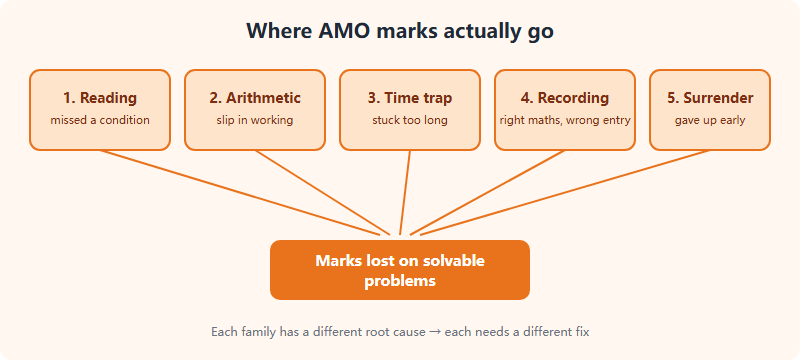
Here is the full taxonomy, with the symptom you will see in a marked paper, the real root cause, and the fix that actually works:
| Family | Symptom on the paper | Root cause | Fix that works |
|---|---|---|---|
| 1. Reading errors | Answered a different question (“smallest” instead of “largest”, ignored “positive integer”, missed “in total”) | Eyes race ahead under time pressure; conditions live only in the question, not in the working | Underline every constraint before starting; restate the question in one line at the top of your working |
| 2. Arithmetic slips | Correct method, wrong number midway (7×8=54, sign flip, dropped digit) | Doing too many steps mentally; working memory overload | Write one more step than feels necessary; recompute the single most fragile step before moving on |
| 3. Time traps | Two hard problems consumed a large share of the time; easier problems later were rushed or left blank | Ego attachment (“I almost have it”) plus no exit rule | A hard exit rule: if no meaningful progress after your time budget, mark it, move on, return later |
| 4. Recording errors | Working shows 24; recorded answer is 42, or the answer to the previous question | Transfer happens at the moment of lowest attention — right after “solving” feels finished | A 3-second point-and-check ritual: point at the result in your working, point at the recorded entry, confirm they match |
| 5. Early surrender | Blank or one-line attempts on problems the student could partially solve; no answer recorded at all | Believing competition problems are all-or-nothing | Since AMO does not deduct for wrong answers, always record your best attempt; train “one more small case” before quitting |
Fixing reading errors: the two-pass protocol
Reading errors are the most common family we see in students from Grades 2 through 8, and they are almost never about English ability alone. Even native speakers skip conditions when adrenaline is high. The fix is a two-pass protocol:
- Pass 1 — hunt for constraints. Before doing any mathematics, underline every condition word: positive, integer, distinct, consecutive, at most, in total, each, remainder. Younger students can circle numbers and box the actual question (“what is being asked?”).
- Pass 2 — restate. Write a one-line restatement at the top of your working: “Find: largest 3-digit number, digits distinct, divisible by 4.” If your restatement is wrong, you will usually notice, because it feels incomplete.
This costs perhaps 20 seconds per problem and repays itself many times over. In practice papers, ask your child to grade themselves twice: once for the answer, once for whether their restatement matched the question. A student who restates correctly but answers wrongly has a mathematics gap; a student who restates wrongly has a reading habit to fix. Those are different training programmes, and conflating them wastes months.
For students earlier in the pathway, this pairs naturally with the vocabulary work we recommend — AMO is delivered in English, and knowing exactly what “quotient” or “consecutive” pins down is a precondition for the underlining to mean anything. (If you are still choosing a starting level, see our overview of AMO grade levels from Grade 2 to Grade 12.)
Fixing arithmetic slips and time traps
Arithmetic slips cluster at predictable places: multi-digit multiplication done mentally, negative signs across an equals sign, and fraction operations under time pressure. The counterintuitive fix is to slow down at exactly one moment — the single most fragile step of each problem — rather than trying to be uniformly careful, which no one can sustain for a whole paper. Teach your child to name the fragile step out loud in practice (“the risky step here is the 17×24”) and to recompute just that step once. One targeted check beats ten anxious re-reads.
Time traps are a strategy failure, not a knowledge failure. The pattern is always the same: a problem resists, the student thinks “I almost have it,” and five minutes later the clock has quietly eaten the time that three easier problems needed. Because AMO awards no negative marks, the rational strategy is to secure every accessible mark first, then reinvest remaining time in the hardest problems. Build the exit rule into practice: set a per-problem time budget appropriate to your level, and when the budget expires without a clear path forward, the student must write down their best current guess, mark the problem, and move on. The rule only works if it is rehearsed until it is automatic — a rule adopted on competition morning will lose to adrenaline every time. Exact paper length and timing vary by level and year, so calibrate your budgets against the current official information on the SIMCC / AMO pages rather than a fixed number.
The error log: turning mistakes into a personal syllabus
The single highest-leverage tool in AMO preparation is not a textbook. It is a notebook with four columns. After every practice paper, the student logs each lost mark:
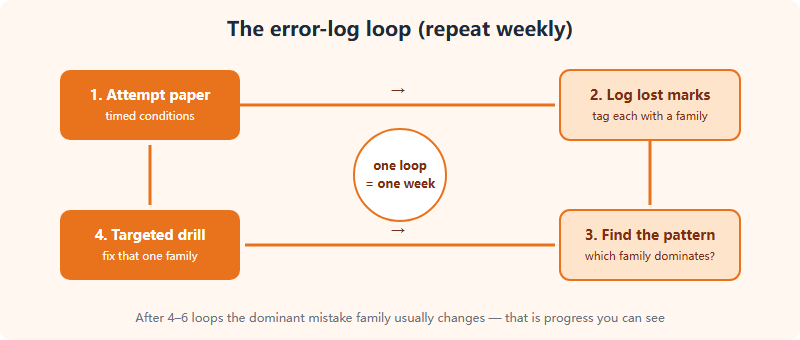
- Column 1 — the problem (paper, number, topic).
- Column 2 — the family (reading / arithmetic / time / recording / surrender / genuine knowledge gap).
- Column 3 — the exact moment it went wrong, in the student’s own words (“I read ‘at least’ as ‘exactly’”).
- Column 4 — the rule that would have prevented it (“underline quantifier words”).
After three or four papers, the log stops looking random. One family will dominate — and that family, not a generic topic list, becomes the next fortnight’s training focus. This is also the honest way to decide whether a student needs more content teaching or more exam craft: if fewer than a third of lost marks are genuine knowledge gaps (which is what we typically see for students who have covered their grade band’s material), then more worksheets will not move the score. Craft will.
Parents can help most by keeping the log blame-free. The log records mechanisms, not character flaws. A child who feels safe writing “I panicked and guessed” will improve; a child who hides mistakes will plateau.
Mistake priorities by grade band
The dominant family shifts predictably as students get older, so weight your review accordingly:
- Grades 2–4: reading errors and recording errors dominate. Attention spans are short and transfer steps are fragile. Prioritise the restatement habit and the point-and-check ritual; keep sessions short.
- Grades 5–8: arithmetic slips and time traps rise as problems get longer. This is the age to introduce the fragile-step check and hard exit rules, and to start the error log in earnest.
- Grades 9–12: early surrender becomes the expensive family — older students often refuse to record partial attempts on problems that feel “beneath a full solution.” Since wrong answers cost nothing, an educated attempt is always better than a blank.
Whatever the band, remember the strategic frame: AMO is a percentile competition with medal bands for roughly the top tiers of entrants (see the published medal structure in our scoring guide, and confirm current details on the official pages). You are not competing against the paper; you are competing against other students who make these same five mistakes. The student who repairs two families gains ground on every competitor who repairs none. And if you are entirely new to the competition, start with the fundamentals in What Is AMO — A Parent’s Guide, including the essential clarification that AMO (run by SIMCC of Singapore with SIU) is a different competition from the American AMC run by the MAA.
FAQ
Are careless mistakes normal in AMO, or a sign my child is not ready?
Completely normal — they dominate lost marks at every level. Readiness is shown by the trend: with an error log and targeted drills, the dominant mistake family should shift within four to six practice papers.
Should my child guess on AMO problems they cannot solve?
Yes. AMO scoring does not deduct marks for wrong answers, so a considered attempt is always better than a blank. Train the habit of recording a best guess before moving on. Confirm current scoring rules on the official AMO pages.
How much practice-paper review time is enough?
A useful rule: review time should roughly equal attempt time. A paper attempted in an hour deserves close to an hour of logging, classifying and re-solving. Attempting papers without structured review is the most common wasted effort we see.
My child keeps misreading questions. Is that an English problem?
Sometimes, but usually it is a habit problem that native speakers share. Test it: if the child can restate the question correctly when asked to slow down, the fix is the underline-and-restate protocol, not more English tuition.
This site is operated by Hanlin Education as an authorized AMO registration partner for China. The AMO (American Mathematics Olympiad) is run by SIMCC and SIU; we are not the organiser. Competition formats, dates, fees and rules should always be confirmed on the official SIMCC / AMO pages. If you spot an error in this article, we will correct it within 7 working days.