
A workable AMO (American Mathematics Olympiad) plan for Grades 6-8 runs about 12 weeks at three to four focused hours a week, in three phases: weeks 1-5 build the core topic strands, weeks 6-9 drill them under time pressure, and weeks 10-12 rehearse full past papers and fix weak spots. Below is a concrete schedule a middle-school student can follow. AMO is run by SIMCC in Singapore with Southern Illinois University — it is not the MAA’s AMC — so confirm your contest date on the official pages and count back twelve weeks.
Why a 12-week, three-phase shape works for this age
The Middle division (Grades 6-8) is the level where AMO shifts from enriched school maths to genuine contest maths: questions start combining two topic strands at once, and the back sections of the paper carry the most marks. Cramming does not suit that. What works is a steady build — learn the ideas, then learn to use them fast, then learn to hold it together for the full timed paper.
Three to four hours a week is deliberately modest. Most Grade 6-8 students are also juggling school, and AMO rewards consistent thinking far more than marathon weekend sessions. Because awards are ranked by percentile — the top ~40% earn a medal (Gold 8%, Silver 12%, Bronze 20%) with no penalty for wrong answers — the goal is steady, broad competence, not a single heroic topic. If your child is new to all this, start with what AMO is and confirm placement against the grade levels from Grade 2 to 12 before week one.
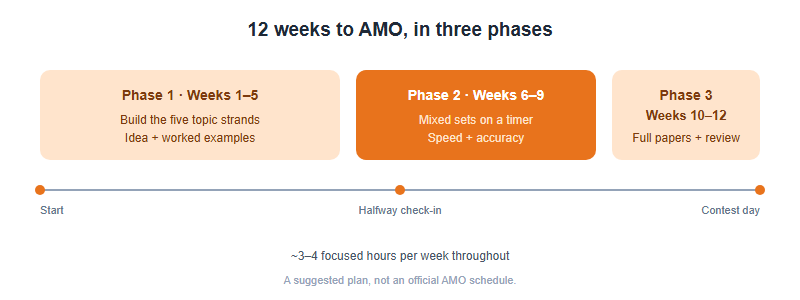
Phase 1 (Weeks 1-5): build the strands
Spend each week on one of AMO’s recurring topic strands, at Middle-division depth. The pattern each week is the same: learn the core idea, study three or four worked examples, then do a small set of practice questions on just that topic. Do not time anything yet — the aim is understanding.
| Week | Strand focus (Grade 6-8 depth) | Sample skills to nail |
|---|---|---|
| 1 | Number theory | Divisibility rules, factor counting, LCM/HCF, simple remainders |
| 2 | Algebra & sequences | Forming equations from words, arithmetic sequences and their sums |
| 3 | Geometry | Angle chasing, area by decomposition, triangle/quadrilateral facts |
| 4 | Counting & combinatorics | Systematic casework, simple permutations and combinations |
| 5 | Logic & problem-solving | Working backwards, extremal “largest/smallest” questions, simple invariants |
A practical tip for international-school students: keep a running list of the English maths terms you meet — “remainder”, “consecutive”, “at most”, “product”, “perimeter”. A misread word, not weak maths, is one of the most common reasons a strong Grade 7 student drops a question.
Phase 2 (Weeks 6-9): practise under time
Now the goal is to do the same maths faster and more reliably. Switch from single-topic sets to mixed sets that blend strands, and start using a timer. The AMO paper mixes quicker multiple-choice questions with higher-value short-answer questions, so pacing is a skill in itself — the exact question count and time limit are set by SIMCC and can vary by grade, so confirm them on the official AMO pages (we break the section weighting down in our scoring guide).
- Week 6: 10-question mixed sets, generous time. Goal: accuracy first.
- Week 7: 15-question mixed sets, moderate time. Start tracking which strand costs you marks.
- Week 8: half-paper sets under realistic time. Practise filling every multiple-choice box — with no penalty, a blank is strictly worse than a guess.
- Week 9: half-paper sets, plus 30 minutes re-studying your single weakest strand from Phase 1.
The most valuable habit here is the mistake log: after every set, sort each lost mark into a strand. By the end of Phase 2 you will have a precise weakness map instead of a vague feeling that “geometry is hard”.
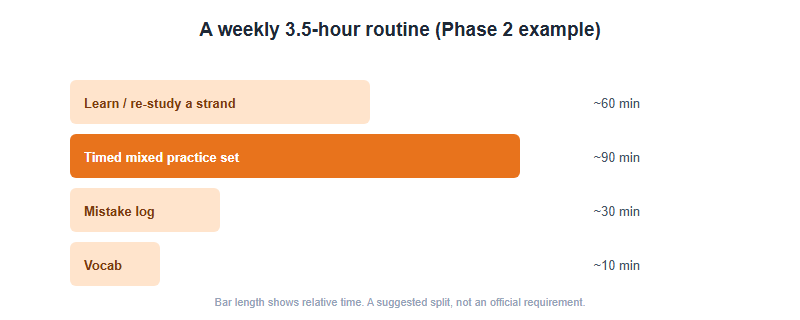
Phase 3 (Weeks 10-12): full papers and final sharpening
In the final three weeks, sit complete past papers under exam conditions — a full timed paper, no interruptions, answer sheet filled as you go. This is where pacing, stamina and nerves get rehearsed so contest day feels familiar.
- Week 10: one full timed paper. Then spend a session reviewing every error by strand and re-solving each one properly.
- Week 11: a second full paper, focusing on a weighted pace — bank the front-section marks quickly so the high-value back questions get the time they need.
- Week 12: a final light paper early in the week, then taper. Re-read your mistake log and vocabulary list rather than cramming new material. Rest before the contest.
A note on integrity and expectations: this plan is designed to make a capable student calmer and sharper, not to promise any particular award. AMO ranks a large international field, results vary, and a medal is never guaranteed by a study plan. The real win at Grades 6-8 is a student who has learned to think through unfamiliar problems — a skill that pays off well beyond one contest.
Four mistakes that derail a 12-week plan
Most plans fail not because the student lacks ability but because of predictable process errors. Watch for these:
- Practising only your strong strand. It feels productive and it is comfortable, but it adds almost no marks. The mistake log exists precisely to drag attention back to the two strands quietly costing you points.
- Marking right/wrong without re-solving. Knowing you got a question wrong changes nothing; working it through until you could teach it is what locks the method in. Budget the review time, do not skip it.
- Timing everything from week one. Speed built on shaky understanding just produces fast wrong answers. Phase 1 is deliberately untimed for a reason — accuracy first, then speed.
- Cramming the final week. Learning new topics in week 12 raises anxiety without raising scores. Taper, review what you already know, and protect the student’s sleep before contest day.
Parents can help most by guarding the rhythm rather than the content: a fixed weekly slot, a quiet space, and a calm attitude to mistakes do more for a Grade 6-8 student than any extra worksheet. Treat a wrong answer in practice as information, never as a verdict — that mindset is what keeps a young student willing to attempt the hard, high-value questions where AMO awards are actually decided.
How the plan maps onto the paper on the day
It helps to remember what all this practice is building toward. The AMO paper combines multiple-choice and higher-value short-answer questions across sections of increasing difficulty (the exact question count, timing and section layout are set by SIMCC and can vary by grade — confirm on the official AMO pages). The 12-week plan trains each piece of that: Phase 1 builds the maths the harder sections demand, Phase 2 builds multiple-choice speed, and Phase 3 rehearses holding all of it together under time. Because there is no penalty for a wrong answer, the plan also drills one simple discipline — never leave a multiple-choice box blank — which alone can lift a borderline student a percentile band. For the full breakdown of how the sections are weighted, see our scoring guide.
Self-study or coaching for the 12 weeks?
This plan is fully doable as self-study with good past papers and a parent helping to keep the rhythm. Some families add light coaching in Phase 2-3, mainly to get faster feedback on why a method failed rather than just whether the answer was right. Neither route is “the” answer — it depends on the student’s independence and how much feedback they need. We compare the two honestly, with the trade-offs, in our piece on getting started with AMO; the right call is the one that keeps the student consistent without burning them out.
Frequently asked questions
How long before AMO should a Grade 6-8 student start preparing?
About 12 weeks at 3-4 hours a week is a comfortable runway. Confirm your contest date on the official AMO pages and count back twelve weeks to set your start.
How many hours a week does this AMO plan need?
Roughly 3-4 focused hours. Consistency matters far more than long weekend sessions, since AMO rewards steady problem-solving across several topic strands.
What should the last week before AMO look like?
Taper. Sit one light paper early, then review your mistake log and maths vocabulary instead of learning new topics, and rest before contest day.
Will this plan guarantee a medal?
No. AMO awards are ranked by percentile across a large field and results vary. A good plan improves readiness and confidence, but no medal is ever guaranteed.
This site is operated by Hanlin Education as an authorized AMO registration partner for China. AMO (American Mathematics Olympiad) is run by the Singapore International Math Contests Centre (SIMCC) together with Southern Illinois University (SIU); it is a SIMCC contest from Singapore and is not the AMC run by the MAA in the United States. We are a registration partner, not the organiser. Contest dates, paper format and award thresholds are set by SIMCC and can change — always confirm current details on the official SIMCC / AMO pages before registering. If you spot an error, we will correct it within 7 working days.