
The American Mathematics Olympiad (AMO) paper is one 90-minute test split into three parts: Section A (15 multiple-choice questions, 3 marks each), Section B (5 short-answer questions, 5 marks each) and Section C (5 short-answer questions, 6 marks each) — 25 questions, 100 marks in total, with no penalty for wrong answers. Understanding how each section is weighted is the single biggest lever a student has on the day. AMO is run by SIMCC (Singapore) with Southern Illinois University — it is not the MAA’s AMC.
The three sections, by the numbers
Most students walk into AMO treating all 25 questions as equal. They are not. The marks per question rise as you move through the paper, so the back half of the test carries far more weight than the front. Here is the structure as described on the official SIMCC / AMO pages — always confirm the current year's exact format before you sit.
| Section | Question type | No. of questions | Marks each | Section total |
|---|---|---|---|---|
| A | Multiple choice | 15 | 3 | 45 |
| B | Short answer | 5 | 5 | 25 |
| C | Short answer | 5 | 6 | 30 |
| Total | 25 | 100 | ||
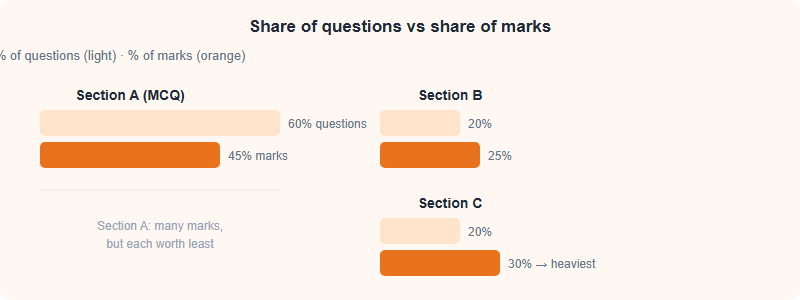
Read those numbers carefully. Section A is 60% of the questions but only 45% of the marks. Sections B and C together are 40% of the questions yet 55% of the marks — and Section C alone is worth 30 points, more than double the weight of any single Section A question. There is also no penalty for a wrong answer, which changes the optimal strategy completely (see how AMO scoring works).
What each section is really testing
The three sections do not just differ in marks — they reward different skills, and that should shape how a student trains.
- Section A (multiple choice): speed and accuracy on standard, curriculum-aligned questions. Because the answer is one of the given options, a student can sometimes work backwards from the choices, estimate, or eliminate. With no penalty for guessing, every Section A box should be filled in, even on a question you could not fully solve.
- Section B (short answer): the bridge. These reward students who can carry out a multi-step method cleanly and write a single correct final answer — no options to lean on, but the problems are usually a notch below Section C in creativity.
- Section C (short answer): the differentiators. These are the non-routine, "think" problems that separate the top awards. At 6 marks each, two solved Section C questions are worth as much as four Section A questions. This is where medals are won.
If you are still deciding whether the contest fits your child at all, start with our explainer on what AMO is and the grade levels from grade 2 to 12, since the difficulty of all three sections scales with the level.
A 90-minute time plan that protects your marks
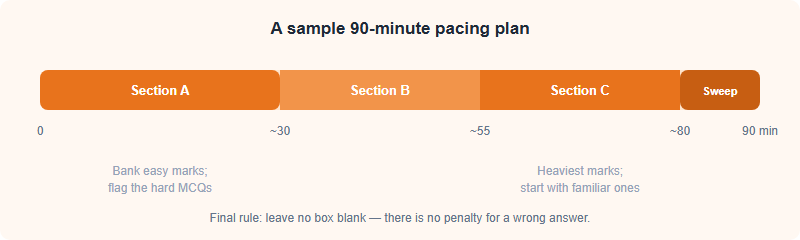
Ninety minutes for 25 questions is an average of 3.6 minutes each — but spending it evenly is a mistake, because the cheap questions sit at the front. The plan below is a starting template our coaches share; adjust it to the student's grade and speed, and rehearse it on timed past papers so it becomes automatic.
| Phase | Roughly | What to do | Why |
|---|---|---|---|
| 1. Sweep Section A | ~30 min | Answer every MCQ you can do quickly; mark the 2–3 hardest and move on | Bank the easy 45 marks fast; don't let one MCQ eat 8 minutes |
| 2. Work Section B | ~25 min | Do all 5 carefully, showing method on paper even though only the answer is graded | Method on paper catches slips; these 25 marks are very gettable |
| 3. Attack Section C | ~25 min | Pick the 2–3 Section C questions that look most familiar first | The 30-mark section is where awards are decided |
| 4. Final sweep | ~10 min | Fill in every blank (no penalty), recheck marked questions, confirm answer-sheet boxes | An empty box scores zero; a guess might score 3 |
Three section-specific habits worth more than extra drilling
Beyond raw practice, a few habits keyed to AMO's structure tend to add marks immediately — especially for international-school students sitting an English-language paper.
1. Transfer answers section by section, not at the end. Students who leave all the answer-sheet copying to the last five minutes routinely mis-shade a Section A bubble or write a Section B answer in the wrong row. Copy each section's answers as you finish it.
2. Read the maths vocabulary deliberately. A Section C problem can hinge on one word — "remainder", "product", "consecutive", "at most". Misreading the term, not the maths, is a common reason a strong student loses a 6-mark question. Build the vocabulary in advance so the language never costs you a mark.
3. Never leave Section A blank — ever. With no penalty for wrong answers, an unanswered MCQ is strictly worse than a guess. In the final sweep, fill every empty box; on a 15-question MCQ section, even a couple of lucky guesses can move you up a percentile band, and AMO awards are ranked by percentile.
A worked example: where two students gain and lose
Numbers make the strategy concrete. Imagine two students sitting the same level. Both are capable, but they spend their 90 minutes differently — and the section weighting turns that into a real gap on the answer sheet.
| Student A (even pacing) | Student B (weighted pacing) | |
|---|---|---|
| Section A (45 max) | 13/15 correct → 39 | 12/15 correct → 36 |
| Section B (25 max) | 3/5 correct → 15 | 4/5 correct → 20 |
| Section C (30 max) | 1/5 correct → 6 (ran low on time) | 3/5 correct → 18 |
| Total /100 | 60 | 74 |
Student A actually got more Section A questions right, yet finished 14 marks behind — because rushing the front of the paper and arriving at Section C with no time left forfeits the heaviest marks. Student B gave up three cheap marks at the front to bank twelve expensive ones at the back. Since AMO awards are ranked by percentile, that 14-mark swing can mean a whole medal tier. The lesson is not "ignore Section A" — it is "don't let easy marks consume the time the hard marks need."
How the structure connects to awards
AMO medals are decided by global rank, not a fixed pass mark: the top 8% earn Gold, the next 12% Silver, the next 20% Bronze, and the next 10% an Honourable Mention. Because the field is ranked, the marks you secure in the high-value Sections B and C are what lift you past other students clustered near the same Section A score. Two clean Section C solutions can be the difference between a Bronze and a Silver. That is why the time plan above protects Section C rather than treating the paper as a flat run of 25 questions.
Frequently asked questions
How many questions are on the AMO paper?
Per SIMCC, 25 questions over 90 minutes: Section A has 15 multiple-choice (3 marks each), Sections B and C have 5 short-answer each (5 and 6 marks). Confirm on amo.simcc.org.
Is there a penalty for wrong answers in AMO?
No. AMO has no penalty for incorrect answers, so you should attempt every question and leave no box blank in the final sweep.
Which AMO section matters most?
Section C carries the most weight at 6 marks per question (30 marks total). It is where top awards are decided, so it deserves protected time near the end.
Does the AMO format change by grade?
The section structure is consistent across levels, but question difficulty scales with the grade. Always check the current year's paper details on the official AMO pages.
This site is operated by Hanlin Education as an authorized AMO registration partner for China. AMO (American Mathematics Olympiad) is run by the Singapore International Math Contests Centre (SIMCC) together with Southern Illinois University (SIU); it is a SIMCC contest from Singapore and is not the AMC run by the MAA in the United States. We are a registration partner, not the organiser. Paper structure, marks, formats and award thresholds are set by SIMCC and can change — always confirm current details on the official SIMCC / AMO pages before registering. If you spot an error, we will correct it within 7 working days.