
For the American Mathematics Olympiad (AMO), past papers are the most reliable preparation resource you have: they match the real format — 25 questions across Sections A, B and C, 100 marks in 90 minutes, no penalty for wrong answers. But most students under-use them, treating each paper as a one-off quiz. This 6-step method turns past papers into genuine training. AMO is run by SIMCC (Singapore) with Southern Illinois University — it is not the MAA’s AMC.
Where to find legitimate AMO practice material
Before any method, get the right material. Quality and source matter more than quantity — a handful of authentic, recent papers beats a pile of mismatched worksheets. Always confirm what is officially available on the SIMCC / AMO pages; the table below describes the types of resource families typically use.
| Resource type | What it gives you | How to use it |
|---|---|---|
| Official AMO sample / past papers | True difficulty, true section weighting, true wording | Your core resource — save the most recent for full timed mocks |
| Official answer keys | Confirmed correct answers to mark against | Mark honestly; an answer key without worked steps still tells you right vs wrong |
| Topic worksheets (Common Core aligned) | Drilling on a single weak topic | Use after a mock reveals a gap — targeted, not random |
| Earlier-year papers | Extra volume at the same standard | Use for section-by-section practice once you know your weak section |
If you are not yet sure the contest fits your child, read our explainer on what AMO is and the grade levels from grade 2 to 12 first, because past papers must be at the right level to be useful — a grade-4 student practising a grade-8 paper learns mostly frustration.
The 6-step method
The aim is to move a paper from "I scored X" to "I know exactly which marks I am leaving on the table and why." Work through all six steps for each full paper rather than stopping at the score.
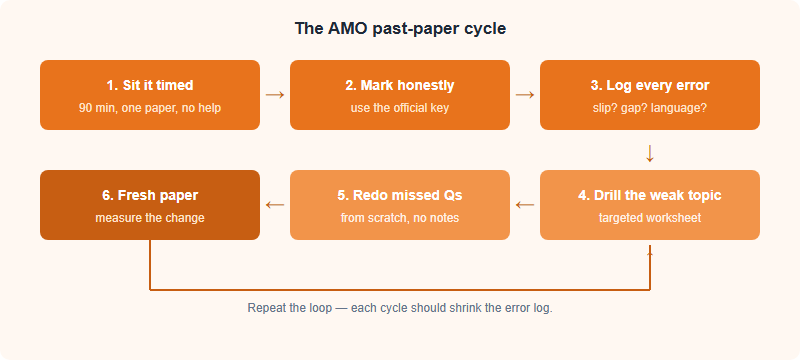
Step 1 — Sit it timed. Do a whole paper in one 90-minute block, no phone, no parent help, answer sheet included. The point is to rehearse the real experience, including the section-by-section pacing (more on the scoring and weighting here). A paper done leisurely over an afternoon teaches almost nothing about exam-day performance.
Step 2 — Mark honestly with the official key. No part-marks fudging, no "I basically had it." Record the raw score out of 100 and, separately, the score in each section. The section split is the most useful number you will get — it tells you whether you are losing marks on cheap Section A questions or on high-value Section C.
Step 3 — Log every error by type. This is the step that separates real preparation from practice theatre. For each lost mark, tag the cause: a careless slip (you knew it), a knowledge gap (you did not know the method), or a language miss (you misread an English term). The pattern across a few papers tells you exactly what to fix.
Step 4 — Drill the weak topic, not everything. If the log shows fractions or number patterns repeatedly costing you marks, spend the next session on a focused worksheet for that one topic. Random general practice is far less efficient than targeted repair of a named gap.
Step 5 — Redo the missed questions from scratch. A week later, re-attempt the questions you got wrong, with no notes. Getting them right now proves the gap is closed; getting them wrong again proves you only read the solution rather than learned it.
Step 6 — Take a fresh paper and measure. Use a new paper to check whether the section score actually moved. Improvement you can see on a fresh timed paper is real; improvement on a paper you have already seen is mostly memory.
An error log beats a score every time
The single highest-leverage habit here is the error log. A score tells you how much you lost; the log tells you why, which is the only thing you can act on. Keep it simple — a notebook or a one-line-per-mistake table is enough.
| Paper | Q (section) | Topic | Cause | Fix |
|---|---|---|---|---|
| Paper 1 | B3 | Remainders | Knowledge gap | Worksheet on division & remainders |
| Paper 1 | A11 | Percentages | Careless slip | Slow down; re-read the question |
| Paper 1 | C2 | Counting | Language ("at most") | Learn comparison vocabulary |
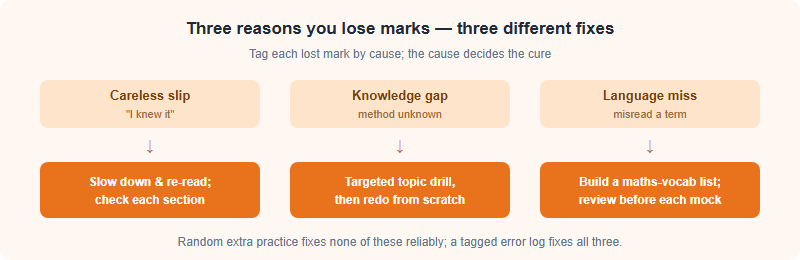
A first-party note from students we help register and prepare: the most common reason a capable child plateaus is doing lots of papers but never keeping an error log — so the same slip recurs paper after paper. The students who improve fastest are not always the ones doing the most papers; they are the ones whose error log gets shorter each cycle.
Past-paper tips specific to AMO
A few pointers keyed to AMO's exact design make past-paper practice pay off faster, especially for international-school students sitting an English-language paper.
- Practise the "no blank boxes" rule. Because AMO has no penalty for wrong answers, train yourself to guess any unsolved Section A multiple-choice question in the final minutes. Build that reflex on every practice paper so it is automatic on the day.
- Protect Section C in your mocks. Each Section C question is worth 6 marks — double a Section A question. Rehearse leaving genuine time for the back of the paper instead of running out of clock on easy MCQs.
- Keep a personal vocabulary list. Every English maths term that has ever cost you a mark goes on one list — "consecutive", "product", "at most", "remainder". Review it before each mock so language never decides a Section C answer.
- Match the level honestly. Practise at your real grade level. A paper that is far too hard inflates your error log with noise; a paper that is far too easy teaches nothing new.
A sample 6-week build using past papers
To make the loop concrete, here is how the six steps fit into a calm six-week run-up — no cramming, one full paper a week, with the mid-week session aimed only at whatever the error log flagged. Stretch or compress it to suit the student; the shape matters more than the exact weeks.
| Week | Weekend: full timed paper | Midweek: targeted repair |
|---|---|---|
| 1 | Paper 1 — baseline; record section scores | Top error-log topic (e.g. fractions) |
| 2 | Paper 2 — note if the weak section moved | Second error-log topic + vocab list |
| 3 | Paper 3 — redo Paper 1's missed questions first | Section C non-routine practice |
| 4 | Paper 4 — focus pacing: protect Section C time | Whatever the log still shows |
| 5 | Paper 5 — full dress rehearsal, answer sheet and all | Light review; trim the vocab list |
| 6 | Rest / one light paper; confidence, not new content | Re-read the error log only |
Notice that the plan deliberately reuses earlier papers (Week 3 redoes Week 1's misses) and ends light. The final week should build confidence and lock in pacing, not introduce anything new — a tired, anxious student on the day loses more marks to nerves and rushed Section A boxes than to genuine gaps. If a particular section refuses to improve across these weeks, that is exactly the signal to get a second pair of eyes on the working, whether from a teacher or a coach.
How much past-paper practice is enough?
There is no official requirement — quality beats volume. For grades 2–8, a sustainable rhythm is one full timed paper a week in the run-up, each followed by the full six-step loop, plus a short targeted drill mid-week on whatever the error log flagged. That is far more effective than cramming five papers the weekend before with no review in between. The goal of past papers is not to memorise questions — the contest uses fresh ones each year — but to make the format, the pacing and your own recurring mistakes completely familiar, so that on the day there are no surprises except the questions themselves.
Frequently asked questions
Where can I get official AMO past papers?
Check the official SIMCC / AMO pages for the sample and past papers they provide. Be cautious with unverified third-party copies, as wording and answers may be inaccurate.
How many AMO past papers should my child do?
There is no fixed number. Quality beats volume: roughly one full timed paper a week with a proper review loop usually works better than cramming many papers without review.
Do AMO questions repeat year to year?
Treat each year as fresh questions. Past papers build familiarity with the format, pacing and your own weak spots — not a bank of memorised answers. Confirm details on amo.simcc.org.
Should I time the practice papers?
Yes. AMO is 90 minutes for 25 questions, so timed practice is essential to rehearse pacing across Sections A, B and C and to build the no-blank-boxes habit.
This site is operated by Hanlin Education as an authorized AMO registration partner for China. AMO (American Mathematics Olympiad) is run by the Singapore International Math Contests Centre (SIMCC) together with Southern Illinois University (SIU); it is a SIMCC contest from Singapore and is not the AMC run by the MAA in the United States. We are a registration partner, not the organiser. Past-paper availability, formats and rules are set by SIMCC and can change — always confirm current details on the official SIMCC / AMO pages before registering. If you spot an error, we will correct it within 7 working days.