
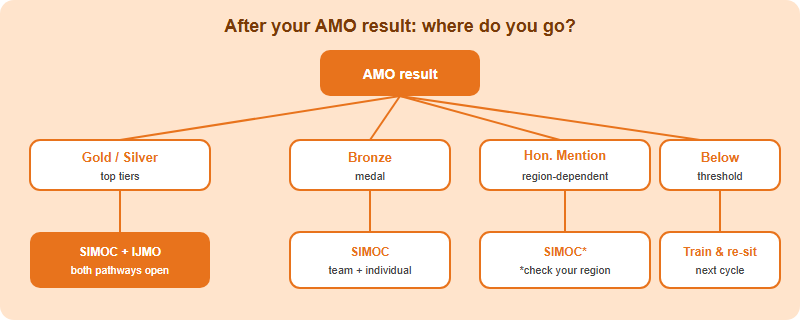
In the SIMCC ecosystem, the American Mathematics Olympiad (AMO) is a feeder round: medal winners earn invitations onward. Broadly, a Bronze award or higher in AMO qualifies a student for SIMOC (the Singapore International Math Olympiad Challenge), while the top medal tiers (Gold/Silver) open the door to IJMO (the International Junior Math Olympiad). Advancement is an invitation to a higher-level international event, not an automatic prize – exact thresholds vary by year and country.
First, get the names straight: AMO is SIMCC’s, not the MAA’s AMC
Before we map the path, one clarification that saves families real confusion. The AMO (American Mathematics Olympiad) in this article is organised by the Singapore International Mastery Contests Centre (SIMCC) together with Southern Illinois University (SIU) Carbondale’s STEM Education Research Center. It launched in 2021, uses the US Common Core Standards as its framework, and is open to Grade 2 to 12 (Primary 2 through to A-Levels in some regions). Per SIU’s June 2026 announcement, it now reaches roughly 50,000 participants across about 50 countries.
This is not the AMC (American Mathematics Competitions) run by the Mathematical Association of America (MAA) in the United States. The AMC is the US national pathway (AMC 8/10/12 → AIME → USAMO → the IMO team) and is aimed mostly at middle and high schoolers. AMO and AMC share a word, not an organiser, a syllabus, or a finals route. If you want the full breakdown, see our explainer on what AMO actually is. The path we describe below – AMO → SIMOC → IJMO – lives entirely inside SIMCC’s world, and has nothing to do with AIME or USAMO.
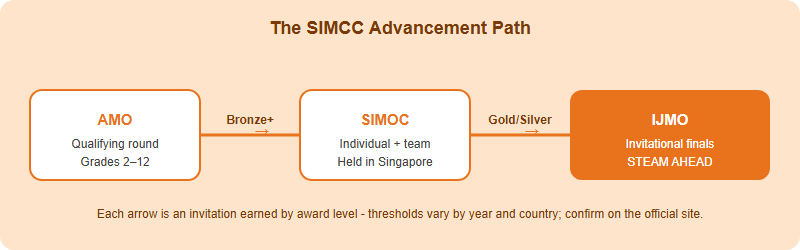
What each contest actually is
“Advancement” only makes sense if you know what you are advancing to. The three rounds are different in character, not just difficulty – AMO is a paper test, SIMOC adds live teamwork, and IJMO is a selective international final.
| Contest | Full name | What it is | Who runs it |
|---|---|---|---|
| AMO | American Mathematics Olympiad | An individual paper-based / online problem-solving round; the entry point most students sit at school | SIMCC + Southern Illinois University (SIU) |
| SIMOC | Singapore International Math Olympiad Challenge | A multi-day event in Singapore combining one individual written contest with two team games (Maths Warriors, Math Master Mind) | SIMCC |
| IJMO | International Junior Math Olympiad | A selective international olympiad held under the STEAM AHEAD banner for higher-tier qualifiers | SIMCC + Scholastic Trust Singapore |
The jump from AMO to SIMOC is the one most families underestimate. AMO is solo work on paper. SIMOC, by contrast, places your child in a team of five students from different countries and grades, assigned by the organisers, who then compete together in the Maths Warriors and Math Master Mind rounds alongside the individual Math Olympiad contest. SIMOC 2025 drew more than 2,300 students from 37 countries – so the social and collaborative leap is as real as the mathematical one.
What “advancement” requires: the medal thresholds
AMO awards medals to roughly the top 40% of participants. The bands are published consistently across SIMCC’s materials and were restated in SIU’s 2026 announcement:
| AMO award | Approx. percentile band | Typically advances to |
|---|---|---|
| Gold | Top 8% | SIMOC and IJMO |
| Silver | Next 12% | SIMOC and IJMO |
| Bronze | Next 20% | SIMOC |
| Honorable Mention | Next ~10% | SIMOC (in many years / regions) |
Read that table as the shape of the path, not a contract. The reliable, repeatedly-published rule is: a Bronze award or higher qualifies you for SIMOC, and Gold/Silver – the top medal tiers – are what carry a student through to IJMO. The exact wording shifts year to year and country to country (some regions extend SIMOC invitations to Honorable Mention; some IJMO pathways admit Bronze winners only through a training programme). Treat the medal percentiles and the curriculum link in our notes on how AMO scoring works as your planning baseline, then confirm the current cut-offs on the official AMO and STEAM AHEAD pages before you bank on a specific invitation.
Timing: how the 2026 calendar lines up
The path is also a calendar. Because each contest feeds the next, the dates only work in one direction – you sit AMO in one cycle, then attend SIMOC or IJMO afterwards. Here is how the published 2026 timeline reads (always reconfirm, as SIMCC extends deadlines and lists some dates as “TBC”):
| Milestone | 2026 timing (per official listings) | Note |
|---|---|---|
| SIMOC 2026 | 17–21 July 2026, Singapore | Registration closed 29 May 2026 (deadline had been extended) |
| AMO 2026 | Paper-based 15–16 Oct 2026; online individual 17 Oct 2026 | Feeds the next cycle’s SIMOC/IJMO, not July 2026 |
| IJMO (STEAM AHEAD) 2026 | Listed around 11–16 December 2026, venue “TBC” | Confirm on the official STEAM AHEAD page |
The key planning takeaway: your AMO sitting and the SIMOC/IJMO you attend belong to different cycles. A strong AMO result in October 2026 is your ticket to the following round of finals, not the July 2026 event whose registration has already closed. For Chinese international-school families weighing whether the timeline fits an application year, this lag is the single most important thing to map early.
What advancement actually means for a young mathematician
Strip away the acronyms and the path is really a progression in kind of challenge – from solo accuracy, to live collaboration, to selective international competition. That arc is what makes the SIMCC ladder useful developmentally, and it maps cleanly onto AMO’s wide grade range, which we cover in detail in our guide to AMO grade levels from Grade 2 to 12.
- AMO → individual mastery. Can the student reason carefully and accurately under timed, paper conditions? This is the foundation everything else is built on.
- SIMOC → collaboration under pressure. Maths Warriors and Math Master Mind put your child on a five-person team with strangers from other countries. Communication, role-sharing and composure suddenly matter as much as raw problem-solving.
- IJMO → selective international standing. Reaching the top medal tiers and being invited onward signals genuine depth relative to a large, multi-country field – a credible, specific line on a record, well beyond “participated in a maths contest.”
It also helps to understand why SIMCC structures the ladder this way. The individual AMO paper measures something narrow but essential – clean reasoning under time pressure. SIMOC then deliberately changes the variable: by assigning your child to a team of strangers from other countries and grades, it tests whether mathematical thinking survives contact with negotiation, divided labour and a ticking clock. IJMO finally reintroduces individual selectivity, but now against a field that has already cleared the earlier bars. For a young mathematician, climbing even one rung is a concrete demonstration that they can adapt their skill to a new format – which is a more honest signal of ability than any single score. That is also why re-sitting after a near miss is rarely wasted: the second attempt is almost always at a higher level of fluency, and the percentile feedback from the first AMO tells you exactly which topics to drill.
A first-party note from our advisors: the families who navigate this path most smoothly are the ones who treat advancement as a two-year horizon, not a single exam. They register the child at the right grade band early, use the AMO result as honest diagnostic feedback (which percentile, which topics cost marks), and only then decide whether SIMOC’s team format and the travel to Singapore fit the family’s calendar and goals. The medal is the headline; the structured progression is the real value – and it works whether a student ultimately advances or simply re-sits stronger next cycle. We never promise a specific medal or invitation, because the cut-offs are set by SIMCC against a moving global field.
Frequently asked questions
Is AMO the same as the American AMC competition?
No. AMO is run by SIMCC (Singapore) with Southern Illinois University for grades 2-12. The AMC is the MAA’s US national contest leading to AIME and USAMO – a completely separate organiser and pathway.
What AMO award do I need to advance to SIMOC?
Generally a Bronze award or higher in AMO qualifies you to join SIMOC. Some regions also invite Honorable Mention winners – confirm the current rule on the official site.
How do students reach IJMO?
IJMO is for higher-tier qualifiers: the top AMO medal levels (Gold/Silver) typically carry through to IJMO under the STEAM AHEAD banner. Exact thresholds vary by year and country.
Does advancing guarantee a prize or admission?
No. Advancement is an invitation to a higher-level contest, not a guaranteed medal or any admissions outcome. Each round is judged on its own against a global field.
This site is operated by Hanlin Education as an authorized AMO registration partner for China. AMO (American Mathematics Olympiad) is run by the Singapore International Mastery Contests Centre (SIMCC) together with Southern Illinois University (SIU); SIMOC and IJMO are SIMCC programmes. We are not the organiser. Dates, qualification thresholds and award percentages can change year to year – always confirm current details on the official SIMCC / AMO / STEAM AHEAD pages. Spotted an error? We correct verified mistakes within 7 working days.