
Yes — AMO is a real, well-established competition, but “official” needs a precise answer. The American Mathematics Olympiad (AMO) is jointly organised by the Singapore International Math Contest Centre (SIMCC) and Southern Illinois University (SIU), with questions framed on the U.S. Common Core standards. It is not the MAA’s AMC, and it is not a U.S. national-body exam. The “American” refers to the curriculum framework, not the governing country.
What “official” actually means for a contest like AMO
When parents ask “Is AMO official?”, they are usually asking one of three different questions at once: Is it a legitimate, real competition? Is it run by a recognised organisation? and Is it the famous American contest I have heard of? The honest answers are: yes, yes, and no — in that order. AMO is a genuine international contest with a clear organiser and a structured advancement path. But it is not run by an American national mathematics body, and it is not the AMC. Conflating “official” with “American national” is exactly where families get misled, so it is worth slowing down and reading each layer honestly.
For the full beginner’s overview of the contest itself, see our companion guide on what AMO is. This article focuses narrowly on the standing-and-legitimacy question, because it is the one that causes the most confusion and the most bad decisions.
Who runs AMO: SIMCC and Southern Illinois University
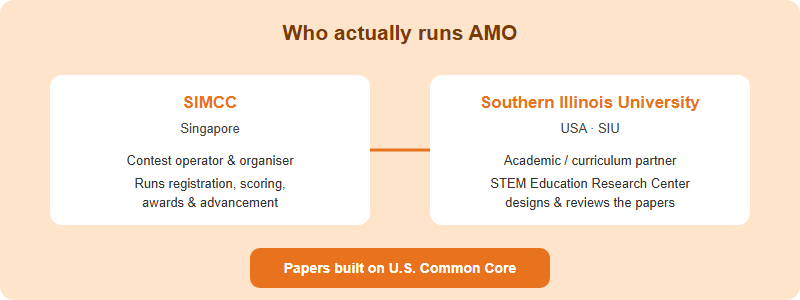
AMO is jointly organised by SIMCC and Southern Illinois University (SIU). SIMCC, based in Singapore, is the contest operator and runs a whole family of international competitions. SIU is a public university in the United States, and its involvement is real and specific: a group of educators from SIU — through its STEM Education Research Center, under the supervision of Dr. Lingguo Bu and Dr. Harvey Henson — contributed to the test curriculum and the question design using their experience with the Common Core mathematics framework.
That is the part worth getting right. SIU’s role is academic and curricular — designing papers and shaping the standards the questions are built on — rather than AMO being “the official competition of the United States.” A U.S. university co-developing the content is a meaningful credential; it is not the same thing as a U.S. national federation sanctioning a national championship. Both statements can be true at once, and an honest reading holds both.
Why “American” is in the name (and why it confuses people)
The word “American” in AMO describes the U.S. Common Core State Standards that the questions are framed around — the same K-12 mathematics framework used across many U.S. school systems. AMO is “American” in the sense that its content is aligned to American school-maths standards and co-designed by a U.S. university. It is not “American” in the sense of being the national competition of the United States.
This is the single most important distinction on the whole page, so here it is plainly: AMO is not the AMC. The AMC — the American Mathematics Competitions — is run by the Mathematical Association of America (MAA) in the United States and is the entry point to the AIME and the USA(J)MO olympiad track, aimed mainly at high-school students. AMO is run by Singapore-based SIMCC for grades 2 through 12. They share three letters and almost nothing else: different organisers, different age ranges, different downstream pathways. If a tutoring centre or a forum post blurs the two, treat it as a red flag about everything else they tell you.
| Question parents ask | Honest answer |
|---|---|
| Is AMO a real, legitimate contest? | Yes — an established international competition run by SIMCC with SIU. |
| Is it run by a U.S. national maths body? | No — the organiser is SIMCC (Singapore); SIU is the academic partner. |
| Is AMO the same as the AMC? | No — the AMC is the MAA’s U.S. contest (AIME / USA(J)MO track). |
| Why is it called “American”? | Because the questions follow the U.S. Common Core framework. |
| Does it lead anywhere bigger? | Yes — top scorers advance to SIMOC and the IJMO track. |
Where AMO sits in the SIMCC ladder — and how to read its standing
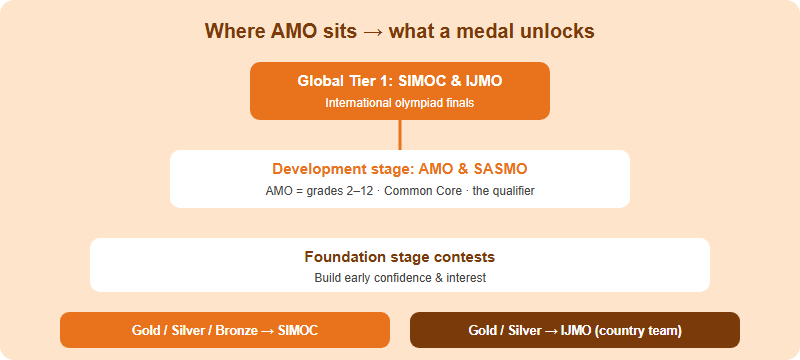
The most useful way to judge AMO’s standing is to see where it sits in SIMCC’s own contest structure, because that tells you what the result actually unlocks. SIMCC organises a tiered ecosystem of competitions. AMO is a development-stage contest — SIMCC labels it a “Tier 3 / local” contest — which sits above the foundation-stage contests and feeds into the global-tier-1 olympiads. In other words, AMO is a serious qualifier, not a terminal trophy: its real value is partly as a gateway.
Here is the concrete, verified part that matters most. Doing well in AMO is what opens the next doors:
- SIMOC (Singapore International Math Olympiad Challenge) — open to eligible primary and secondary students who have first attained a Gold, Silver, or Bronze in AMO or SASMO.
- IJMO (International Junior Math Olympiad) — only Gold and Silver awardees from AMO/SASMO are selected each year to represent their country; Bronze awardees may join only through the IJMO training program.
That is a precise, checkable hierarchy — and it is exactly how you should “read AMO honestly.” It is a legitimate, well-run contest with a transparent advancement path to genuinely international olympiads (SIMOC and IJMO bring together students from many countries). What it is not is the U.S. national championship or a shortcut that “guarantees” anything for university admissions. Treat a medal as evidence of solid, ranked performance in a strong international field and as a key to the next tier — not as a brand-name credential it was never designed to be.
Format and awards: the facts behind the standing
A contest’s standing is easier to judge once you know how it is actually scored. AMO runs one 90-minute paper per level, grouped by grade, with non-routine problems pitched at each grade band (for example, the Grade 8 paper carries around 25 questions; confirm the exact count for your child’s level on the official site). Awards are percentile-ranked, not a fixed pass mark: the top ~40% of participants earn a medal — Gold for the top 8%, Silver for the next 12%, and Bronze for the next 20% — and there is no penalty for wrong answers. For the full mechanics, see how AMO scoring works, and for which paper your child sits, our breakdown of AMO grade levels.
Two implications for “reading it honestly.” First, because awards are percentile-based, a medal reflects your rank in the field that year, not an absolute mastery threshold — which is fair and meaningful, but it means a Gold is “top 8% of entrants,” not “top 8% of all maths students on Earth.” Second, the no-penalty design means a young student is rewarded for attempting every question, which is part of why AMO works well as an encouraging development-stage contest rather than a brutal filter.
How Hanlin fits in — honestly
We want to be just as precise about our own role as about AMO’s. Hanlin Education is an authorized AMO registration partner for China. That means we handle official sign-up with SIMCC, place each child at the correct grade level, and explain the real timeline — so families based in China are not left guessing how to enter an international contest. We are not the organiser of AMO, we do not set the papers, and we do not award the medals; SIMCC and SIU do. Because we sit on the registration side rather than the judging side, we can give you a straight read on whether AMO actually suits your child — and if a different contest (including the high-school AMC track later on) would fit better, we will say so. No competition can guarantee a result or an admission, and any partner who implies otherwise is not being honest with you.
Frequently asked questions
Is AMO an official U.S. competition?
No. AMO is organised by Singapore-based SIMCC with Southern Illinois University. “American” refers to its U.S. Common Core framework, not a U.S. national governing body.
Is AMO the same as the AMC?
No. The AMC is run by the MAA in the U.S. (the AIME/USA(J)MO track, mainly high school). AMO is a different contest by SIMCC for grades 2–12.
Is AMO a legitimate, worthwhile contest?
Yes. It is an established international competition with a transparent advancement path: medallists can progress to SIMOC, and Gold/Silver awardees to the IJMO track.
What is SIU’s actual role in AMO?
Educators from Southern Illinois University’s STEM Education Research Center help design the Common Core-based papers. SIU is the academic partner; SIMCC operates the contest.
This site is operated by Hanlin Education as an authorized AMO registration partner for China. AMO (the American Mathematics Olympiad) is run by SIMCC together with Southern Illinois University — we are not the organiser and do not set papers or award medals. Figures here reflect publicly available information and can change by season; always confirm current details on the official SIMCC / AMO pages. We do not guarantee any result or admission outcome, and corrections are made within 7 working days.