
No — AMO and AMC are two different competitions run by two different organisations. The AMO (American Mathematics Olympiad) is organised by SIMCC of Singapore together with Southern Illinois University, is open to grades 2–12 worldwide, and is built on the U.S. Common Core framework. The AMC (American Mathematics Competitions) is run by the Mathematical Association of America (MAA) in the United States and feeds the AIME → USAMO → IMO selection pipeline. Same word “American,” completely different contests.
The one-sentence answer parents keep searching for
If you only remember one thing from this page: AMO is not the AMC, and the AMC is not the AMO. They look similar because both start with “American” and both are maths contests aimed at school students. But they have different organisers, different countries of origin, different eligible grade ranges, different question formats, and completely different “where does this lead” pathways. Choosing between them — or doing both — only makes sense once you can tell them apart.
This confusion is the single most common question we get from families. It matters because the two contests serve very different goals. The AMC is, in practice, the front door to the United States’ international olympiad team. The AMO is a graded, Common-Core-based contest that welcomes children as young as Grade 2 and rewards a much wider band of participants. Picking the wrong one for your child’s age and goal wastes a year of preparation. (For a plain-English primer first, see our companion piece, What Is AMO.)
Who runs each one — the fact that settles the debate
The cleanest way to separate the two is to look at the organisation behind each contest. This is verifiable on official sources and is the root cause of almost every difference further down.
AMO is jointly organised by the Singapore International Mastery Contests Centre (SIMCC) and Southern Illinois University Carbondale (SIU). SIMCC is based in Singapore and runs a family of contests across the region; SIU is the U.S. university partner whose educators design the Common-Core-aligned papers. The word “American” in the name refers to the curriculum framework (U.S. Common Core State Standards), not to a U.S. governing body and not to the United States as the host country.
AMC is administered by the Mathematical Association of America (MAA), a long-established U.S. mathematics organisation. The AMC is genuinely U.S.-domestic in its core: it is the first step the MAA uses to select students for the American Invitational Mathematics Examination (AIME) and, ultimately, the U.S. team for the International Mathematical Olympiad. When people casually say “the American maths competition,” the MAA’s AMC is usually what they mean — and that is exactly why the AMO’s name causes mix-ups.
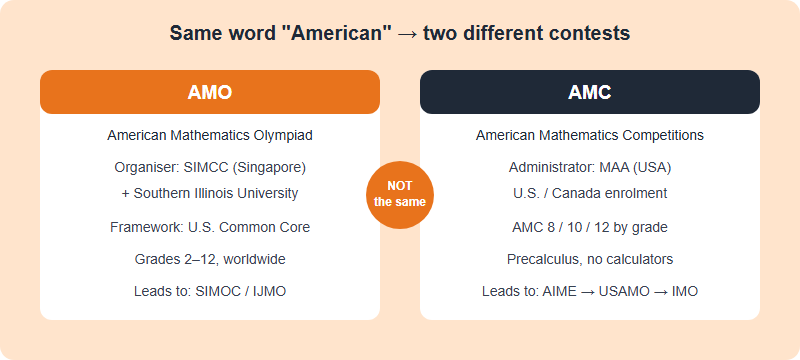
Side-by-side: every difference that matters
Below is the honest, line-by-line comparison. Figures for AMO are drawn from SIMCC’s published contest information; figures for AMC are from the MAA. Both organisers update details year to year, so treat this as a 2026 snapshot and confirm anything decision-critical on the official sites before you register.
| Dimension | AMO (American Mathematics Olympiad) | AMC (American Mathematics Competitions) |
|---|---|---|
| Organiser | SIMCC (Singapore) + Southern Illinois University | Mathematical Association of America (USA) |
| Country of origin | Singapore-run; U.S. curriculum partner | United States |
| Curriculum basis | U.S. Common Core State Standards | U.S. school maths up to precalculus (no calculus) |
| Eligible grades | Grades 2–12 (Primary 2 to Junior College 2) | AMC 8: grade 8 & below; AMC 10: grade 10 & below; AMC 12: grade 12 & below |
| Where students enrol | Open to students worldwide via partners | Accredited school / homeschool in the U.S. or Canada |
| Levels / papers | Differentiated paper for each grade level | Three contests: AMC 8, AMC 10, AMC 12 |
| Duration | 90 minutes per level | AMC 8: 40 min; AMC 10 & 12: 75 min |
| Questions & format | 25 questions including multiple-choice and short-answer sections; no penalty for wrong answers (confirm current section split on the official site) | 25 multiple-choice questions on each contest |
| Awards | Gold ~top 8%, Silver ~next 12%, Bronze ~next 20% (top ~40% earn a medal); Honourable Mention below that | Certificates / distinctions; key outcome is qualifying for AIME |
| What it leads to | SIMOC (all medallists); IJMO (Gold & Silver) | AIME → USAMO / USAJMO → U.S. IMO team |
Read that table top to bottom and the picture is clear: the two contests overlap almost nowhere except the calendar slot in a busy maths family’s year. The AMO starts five grades earlier (Grade 2 vs the AMC’s youngest cohort sitting AMC 8), is open globally rather than to U.S./Canada enrolees, and rewards a wide top 40% with medals. The AMC is narrower, harder per question for its target ages, and its real prize is an invitation to the next exam in the U.S. olympiad ladder.
Format and difficulty feel different in the exam room
The numbers above translate into a very different experience for a student sitting each paper.
AMO gives each grade its own paper, runs for 90 minutes, and mixes multiple-choice with short-answer questions for a total around 100 marks, with no penalty for a wrong answer. Because there is a paper for every grade from 2 to 12, a younger child is not thrown against high-school material — the difficulty is scaled to their level, which is what makes it workable as an early, confidence-building contest. (Our breakdown of how AMO scoring works walks through the marks and medal thresholds in detail.)
AMC uses 25 multiple-choice questions throughout. The AMC 8 is 40 minutes; the AMC 10 and AMC 12 are 75 minutes and cover secondary-school mathematics up to precalculus, with no calculators allowed. The AMC 10/12 also use a scoring rule that rewards leaving a question blank (1.5 points) over guessing wrong (0 points) — a strategic wrinkle the AMO does not have. The questions are designed to spread out very strong students, so the curve is steep: a “good” AMC 10/12 score is often well under half the questions correct.
Where each pathway actually leads
This is the difference most likely to affect a long-term plan, so it deserves its own decision tree. The two contests point at entirely different destinations.
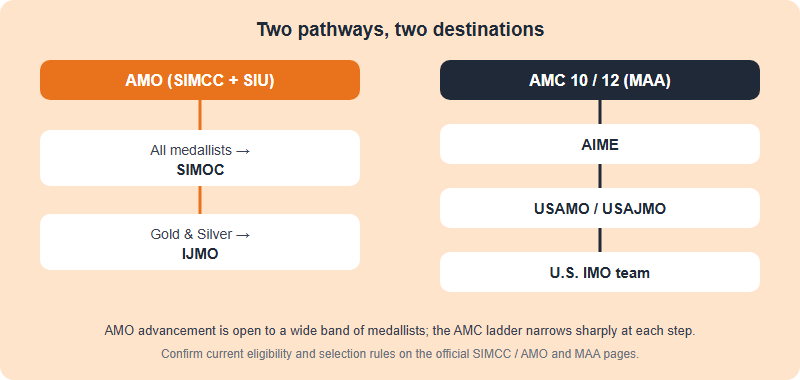
On the AMO side, every Gold, Silver and Bronze medallist is eligible for selection to SIMOC (the Singapore International Math Olympiad Challenge), and Gold and Silver winners are eligible for IJMO (the International Junior Math Olympiad). The progression is broad by design — it is meant to keep a large group of motivated students moving up.
On the AMC side, the funnel is deliberately narrow. Strong AMC 10/12 results earn an invitation to the AIME; top AIME performers are invited to the USAMO (from AMC 12) or USAJMO (from AMC 10); and from there the MAA selects the U.S. team for the IMO. The MAA selects only a few hundred students nationwide for those olympiads each year. These are two genuinely separate ladders — climbing one does not put you on the other.
Which should your child do? An honest take
There is no universally “better” contest — only the right fit for a child’s age, location and goal. A few first-party rules of thumb we use with families at Hanlin, stated plainly:
- Younger students (roughly Grades 2–8). The AMO is usually the more natural starting point, because it has a paper built for each grade and a wide medal band that rewards effort early. The AMC 8 is also open to this age group and is excellent, but it is a single, steeper paper. See AMO grade levels (Grade 2 to 12) to find the right division.
- Students targeting the U.S. olympiad track. If the explicit goal is AIME / USAMO and eventually the IMO selection process, the AMC is the contest that feeds that pipeline. The AMO does not lead there.
- Students outside the U.S./Canada. Note the AMC’s enrolment requirement (an accredited U.S. or Canadian school or homeschool). The AMO is open worldwide through registration partners, which is one practical reason many international families in China sit the AMO.
- Doing both. The two contests are not mutually exclusive and test overlapping skills. Plenty of students sit the AMO for breadth and confidence and the AMC for the olympiad pathway — just budget the calendar and don’t expect one result to substitute for the other.
Whatever you choose, the worst outcome is registering under a misunderstanding — for example, assuming an AMO medal is a U.S.-official AMC distinction, or expecting AMO to be a step toward USAMO. It isn’t. Match the contest to the goal and both can be worthwhile.
Frequently asked questions
Is AMO the same as AMC?
No. AMO is run by SIMCC of Singapore with Southern Illinois University; the AMC is run by the MAA in the USA. Different organisers, grades, formats and pathways.
Is the AMO a U.S.-official competition?
No. “American” refers to its U.S. Common Core curriculum basis, not a U.S. governing body. The organiser, SIMCC, is based in Singapore.
Does doing well in AMO qualify me for AIME or USAMO?
No. AIME and USAMO come only through the MAA’s AMC. AMO medallists advance instead to SIMOC and IJMO.
Can my child do both AMO and AMC?
Yes. They test overlapping skills but are separate contests; many students sit both. Confirm dates and eligibility on each official site.
This site is operated by Hanlin Education as an authorized AMO registration partner for China. The American Mathematics Olympiad (AMO) is organised by SIMCC (Singapore International Mastery Contests Centre) and Southern Illinois University; the American Mathematics Competitions (AMC) are administered by the Mathematical Association of America. We are not the organiser of either contest and do not claim to be. Competition formats, dates, fees and selection rules change year to year — always confirm current details on the official SIMCC / AMO and MAA pages before registering. Spotted an error? We correct verified mistakes within 7 working days.