
Because AMO runs from grade 2 all the way to grade 12, it is one of the few maths competitions you can genuinely plan around for years rather than weeks. A good multi-year roadmap is simple: start when your child is ready, follow their grade level, and decide each year whether to push forward or consolidate — while protecting their enjoyment of maths above any single medal. AMO is run by SIMCC of Singapore (grades 2 to 12); it is not the US AMC.
Why AMO rewards a long view
Most competition advice is written for one season: register, prepare, sit the paper. That is useful, and our overview of AMO and the season calendar cover the yearly cadence well. But AMO's unusual grade span — from Primary 2 up to grade 12 — means a family can also think in years. The organiser, the Singapore International Mathematical Contest Centre (SIMCC), together with Southern Illinois University (SIU), runs a level for almost every school year, so a student can grow alongside the competition instead of meeting it once.
Thinking long-term changes the decisions you make. Instead of asking “how do we cram for this paper?”, you ask “what is this year's job in a bigger arc?” Some years are for building a foundation, some for stretching, and some — importantly — for easing off. That perspective is exactly what protects a child from the burnout that ends so many early competition journeys.
There is also a quieter benefit to planning in years rather than seasons: it lowers the stakes of any single paper. When a family treats AMO as one point on a long line, a disappointing result stops being a verdict and becomes data — useful information about what to work on next. Children read that framing from the adults around them. A student who knows there is always a next year will take more risks on hard problems, and taking risks on hard problems is exactly how you get better at them.
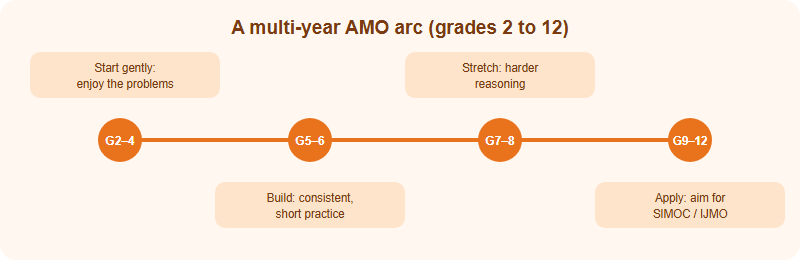
The four phases of a long AMO journey
No two children follow the same path, but a useful default arc has four phases. Treat these as seasons of a journey, not rigid rules, and adjust to the child in front of you.
| Phase | Rough grade band | The job of this phase | What to avoid |
|---|---|---|---|
| Start | Grades 2–4 | Enjoy problems, learn to read maths in English, build number sense | Heavy drilling or timed pressure too early |
| Build | Grades 5–6 | Short, consistent practice; get comfortable finishing a paper | Skipping the review step after each attempt |
| Stretch | Grades 7–8 | Take on harder, multi-step reasoning; keep an error log | Chasing speed before accuracy is solid |
| Apply | Grades 9–12 | Timed papers, self-run review, and possibly aiming for SIMOC / IJMO | Adding pressure in already-busy exam years |
The grade bands here are a planning device, not an official division map — check your child's exact level in the AMO grade-levels guide and confirm boundaries on the official pages. What matters is the shape: gentle at the start, steadily more demanding, and always with review built in.
It also helps to name what does not change across the phases. In every season, the highest-value habit is identical: attempt a problem, check it honestly, and note what you would do differently next time. A grade 3 child does this out loud with a parent; a grade 11 student does it silently in an error log. The tool grows up, but the loop — try, review, adjust — is the engine of the entire multi-year arc.
Each year, run the same simple loop
Within the long arc, every single year runs the same short loop. Keeping it consistent is what makes progress compound instead of restarting from scratch each season.
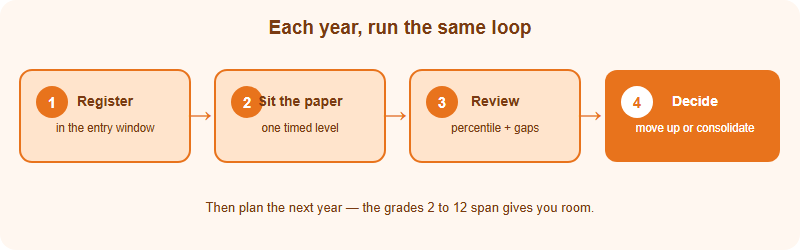
The most under-used step is number four: the decision. After you read the result — and our guide to how AMO scoring works explains what the percentile is telling you — you choose the next year's emphasis. Usually a child simply sits the level matching their new grade, but the real judgement is whether to push for a higher award or consolidate the foundations first.
Keeping a simple, permanent record turns this yearly loop into compounding progress. A single running document — one line per year with the level sat, the rough percentile, and the two or three ideas that cost the most marks — means each new season starts from evidence rather than memory. Over several years that document quietly becomes a map of how a young mathematician grew, and it makes the push-or-consolidate call far easier each time.
When to move up, and when to consolidate
Moving up a grade level happens naturally as your child advances in school. The subtler question is how hard to push for a stronger result at the new level. A rough guide:
- Consolidate when a child is scraping through the current level, making lots of careless errors, or clearly tired. A steady year rebuilding confidence beats a stressful leap.
- Push when a child finishes comfortably, enjoys the harder problems, and is asking for more. That is the moment to aim at a higher percentile band.
- Pause when life is full — a heavy school-exam year, a house move, a dip in motivation. Skipping or easing off for a season is a legitimate strategic choice, not a failure.
Because the grade span is so wide, none of these choices closes a door. A student who consolidates in grade 6 can still stretch in grade 8; a student who pauses in grade 9 can return in grade 10. The long runway is the whole point.
A quick test can settle the push-or-consolidate question. Have your child re-sit last year's level, untimed. If they now find it straightforward and even a little dull, they have outgrown it and are ready to push at the new level. If parts of it still trip them up, a consolidation year — the same level of challenge, cleaner execution — will pay off far more than a stressful leap. Readiness, not the calendar, should set the ambition dial.
Consolidation years are badly underrated. Repeating the same level of challenge with cleaner execution — fewer misreads, tidier working, better use of the clock — often lifts a child's percentile more than a jump in difficulty would, and it does so while rebuilding confidence rather than denting it. There is no rule that every year must be harder than the last; the strongest long-term records usually contain at least one deliberate season of simply getting sharper at what you already know.
Protecting the long game: how to avoid burnout
The biggest threat to a multi-year plan is not difficulty — it is exhaustion. In our experience with international-school families, the students still enjoying competition maths in high school are almost always the ones who were never over-pushed in primary school. A few principles keep the journey sustainable:
- Little and often beats occasional marathons, at every age.
- Celebrate effort and finishing, not only medals — especially since AMO is percentile-ranked and the field is strong.
- Build in lighter years on purpose; a plan with no rest is a plan that breaks.
- Keep it the child's project, not the parent's. Curiosity is the fuel that lasts a decade; pressure runs out fast.
Sustainability also means matching intensity to the season of life. A primary-school year can usually carry a little competition maths comfortably; a year with major school examinations often cannot, and pretending otherwise just breeds resentment. Families who plan the lighter years deliberately — rather than crashing into them by accident — are the ones whose children are still choosing to do AMO five or six years later.
One honest caveat to end on: no roadmap guarantees a particular award, a place at SIMOC or IJMO, or any admissions outcome, and anyone who promises that is not being straight with you. What a good multi-year plan really delivers is a child who keeps getting better at thinking — and keeps wanting to. Over grades 2 to 12, that habit is worth far more than any single result.
Frequently asked questions
When should my child start AMO?
From grade 2 if ready, but readiness matters more than age. The grades 2 to 12 span means there is no single right starting point.
Should we move up a level every year?
Usually you follow the child's grade, but the real question each year is whether to push or consolidate. Progress is rarely a straight line.
How do we avoid burnout over several years?
Keep sessions short and regular, celebrate effort over medals, and build in lighter years. A long arc beats intense cramming.
Where can strong results lead over time?
Top performers can progress toward SIMOC and IJMO. Confirm current qualification criteria on the official AMO and SIMCC pages.
This guide is published by AMO Club, operated by Hanlin Education as an authorized AMO registration partner for China. AMO is run by SIMCC (Singapore) and Southern Illinois University (SIU); we are not the organiser. Competition details — format, levels, awards and progression — can change, so always confirm on the official SIMCC / AMO pages. Spotted an error? We correct verified mistakes within 7 working days.