
What separates students who thrive at the AMO (American Mathematics Olympiad, run by SIMCC of Singapore and SIU) from those who freeze is rarely extra formulas — it is a small toolkit of thinking moves, or heuristics. Seven of them cover the vast majority of non-routine competition problems: work backwards, try small cases, draw it, split into cases, use parity, estimate and eliminate, and make it concrete. This guide explains each move, when to reach for it, and how to train it deliberately.
Why heuristics beat memorisation at AMO
School mathematics mostly asks students to recognise a problem type and apply the matching procedure. Competition mathematics deliberately breaks that link: AMO problems are built so that the right first step is not obvious, even when the underlying content sits comfortably inside the student’s grade band (AMO’s content is aligned with the US Common Core progression — see our grade levels guide for what each band assumes). A student armed only with procedures meets an unfamiliar problem and has nothing to do. A student armed with heuristics has a menu: seven concrete things to try before deciding a problem is out of reach.
This is also why heuristic training compounds across competitions and school work alike. The moves below are the standard toolkit of mathematical problem solving — the same ideas George Pólya catalogued decades ago in How to Solve It — adapted to what we actually see students face in AMO-style papers from Grades 2 to 12. One practical note before we start: AMO’s exact paper format and question mix vary by level and year, so treat the official SIMCC / AMO pages as the source of truth for structure, and treat this article as training for the thinking itself.
The seven moves, one by one
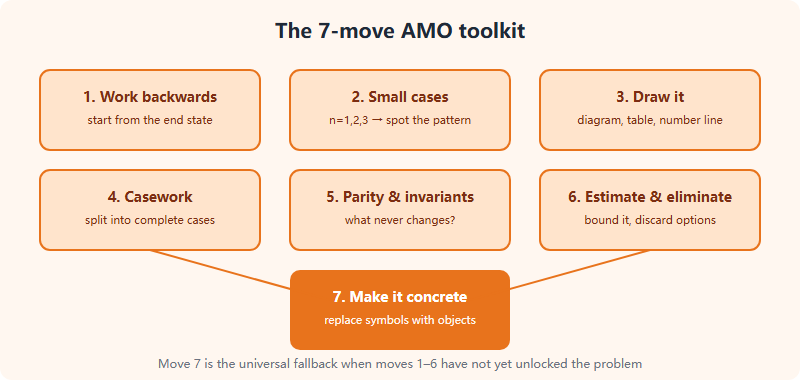
1. Work backwards. When a problem describes a sequence of operations ending in a known result — “after giving away half her stickers and then 3 more, Mia has 7 left” — reverse each step from the end. Younger students find this move transformative because it converts a confusing forward story into a mechanical unwind. At higher grades the same move appears as “assume the answer and check consistency.”
2. Try small cases. Faced with “how many ways for 10 people…” or “what is the 2026th term…”, first solve the same problem for 1, 2, 3, 4. Write results in a row, look for a pattern, then test the pattern on one more case before trusting it. The discipline matters: a pattern verified on a single case is a guess; verified on two further cases, it is a working hypothesis worth building on.
3. Draw it. Rate problems become clear on a double number line; age puzzles collapse into a table; motion problems into a distance diagram. The test of a good drawing is that the constraint you were stuck on becomes visible. Students who “hate geometry” are often students who draw tiny, distorted sketches — teach a big, roughly-to-scale drawing as a non-negotiable first move on anything spatial.
4. Casework. When a condition splits the world cleanly — the digit is even or odd; the largest element is in the set or not — enumerate the cases, solve each, and add. The two skills to drill are completeness (did you cover every case?) and disjointness (did you count something twice?). A written case list, ticked off one by one, prevents both failures.
5. Parity and invariants. Some quantities never change no matter what moves you make: the parity of a sum, a total, a colour count. If a problem asks “can you reach state B from state A?”, compute something that is invariant under the allowed moves; if it differs between A and B, the answer is no — with proof, in one line. Parity is the first invariant students meet, usually around Grades 4–6, and it recurs all the way up the pathway.
6. Estimate and eliminate. Before computing exactly, bound the answer: “it must be bigger than 20 and smaller than 50.” In multiple-choice contexts this alone can eliminate most options; in open-answer contexts it catches slips (“my exact method gave 316 — but my bound said under 50, so I mis-stepped somewhere”). Estimation is also the cheapest self-check that exists, which matters in a competition where, as our scoring guide explains, there is no penalty for a wrong answer — a bounded, educated attempt is always worth recording.
7. Make it concrete. The universal fallback. Replace “some number n” with 12; replace abstract people with named ones; act the process out with coins or drawn boxes. Concretising does not solve the problem — it lets the student see the structure, after which one of moves 1–6 usually applies. There is no age ceiling on this move; strong older students use it constantly and without embarrassment.
Matching the move to the problem: a quick-reference table
| You notice… | First move to try | Back-up move | Typical grade band it first appears |
|---|---|---|---|
| A story of operations with a known end result | Work backwards | Make it concrete | Grades 2–4 |
| A big number where a small one would be the same problem (“the 100th term”, “2026 coins”) | Small cases | Draw a table of results | Grades 3–6 |
| Positions, rates, ages, journeys, overlaps | Draw it | Make it concrete | Grades 2–6 |
| “How many ways…” with a natural split (odd/even, includes X or not) | Casework | Small cases to sanity-check the count | Grades 5–8 |
| “Is it possible to…” with repeated moves or swaps | Parity / invariants | Small cases | Grades 4–8 |
| Answer options far apart, or a computation you distrust | Estimate & eliminate | Work backwards from options | All bands |
| Total abstraction — you cannot even start | Make it concrete | Then re-scan moves 1–6 | All bands |
Two honest caveats about the table. First, the grade bands are indicative training milestones drawn from our coaching experience, not official syllabus boundaries — AMO publishes its own level structure, and you should confirm what your child’s division assumes on the official pages. Second, real problems often need two moves chained (“small cases revealed a parity pattern”), which is exactly why the toolkit is worth drilling as a set rather than as isolated tricks.
The 30-second triage: what to do when you are stuck
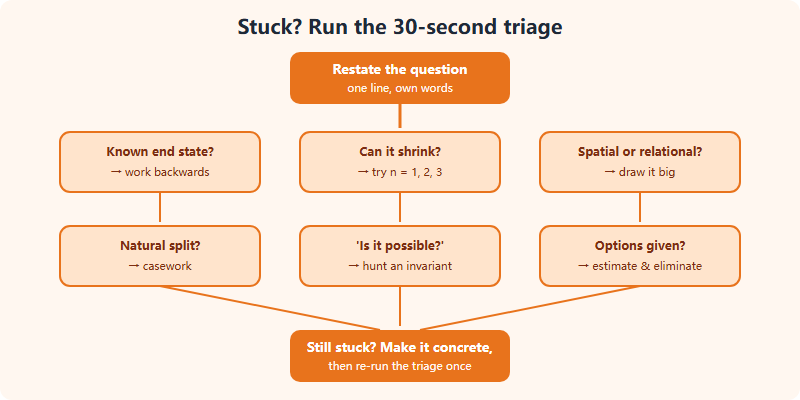
The triage exists because “being stuck” at a competition is usually not a knowledge state — it is a search state, and unguided search under time pressure degenerates into staring. Rehearse the flow until it is automatic: restate the question in one line, scan the six signal questions in order, commit to the first move that fires, and give it a fair attempt. If the move stalls, concretise and re-run the triage exactly once. After that, the time-budgeting rules apply: record your best attempt and move on. (AMO does not deduct marks for wrong answers, so a reasoned guess always beats a blank — details in the scoring guide linked above.)
How to train heuristics deliberately (not accidentally)
Most students meet heuristics accidentally — a tutor shows a trick, it works on that problem, and it is forgotten. Deliberate training looks different:
- One move per week. Spend a week where every practice problem is attacked with the same first move, even when it is not optimal. The goal is fluency with the move itself; efficiency comes later.
- Name the move out loud. After solving (or failing), the student states which heuristic carried the problem: “that was small cases plus a pattern.” Naming builds the mental index that the triage relies on.
- Re-solve with a different move. The single best exercise we know: take a problem you solved with casework and force a solution by drawing, or vice versa. Students discover that moves are interchangeable lenses, which permanently lowers the fear of picking the “wrong” one.
- Log which move was missing. When reviewing a paper, tag each unsolved problem with the move that would have unlocked it. If “small cases” keeps appearing in your log, that is your next week’s theme.
Ten to fifteen minutes a day of this kind of tagged practice comfortably beats a weekly two-hour untagged grind, especially for students in Grades 4–8 who are still building the index. And because the toolkit is competition-agnostic, none of the effort is wasted if your family later adds other competitions to the calendar — though be careful to keep names straight when you do: AMO (SIMCC, Singapore, Grades 2–12) is a different competition from the American AMC run by the MAA in the USA, a distinction we unpack in What Is AMO — A Parent’s Guide.
FAQ
At what grade should a student start learning these heuristics?
Work backwards, draw it, and make it concrete are teachable from Grade 2–3. Casework and parity typically land from Grades 4–6. There is no upper limit — Grade 9–12 students still win marks with the same seven moves.
Do heuristics replace learning the syllabus topics?
No — they multiply it. Heuristics decide what to try; topic knowledge executes it. A student weak on fractions will still stall mid-move. Train both: topics from your grade band, moves from this toolkit.
How is this different from memorising problem types?
Type-memorisation fails the moment a problem is disguised. Heuristics are cues read from the problem’s structure — end state, shrinkability, splits — so they still fire when the surface story is new.
Is guessing with estimate-and-eliminate legitimate?
Yes. Bounding an answer and discarding impossible options is genuine mathematics, and since AMO applies no penalty for wrong answers, a bounded educated attempt is strictly better than a blank. Confirm current rules on the official pages.
This site is operated by Hanlin Education as an authorized AMO registration partner for China. The AMO (American Mathematics Olympiad) is run by SIMCC and SIU; we are not the organiser. Competition formats, dates, fees and rules should always be confirmed on the official SIMCC / AMO pages. If you spot an error in this article, we will correct it within 7 working days.