
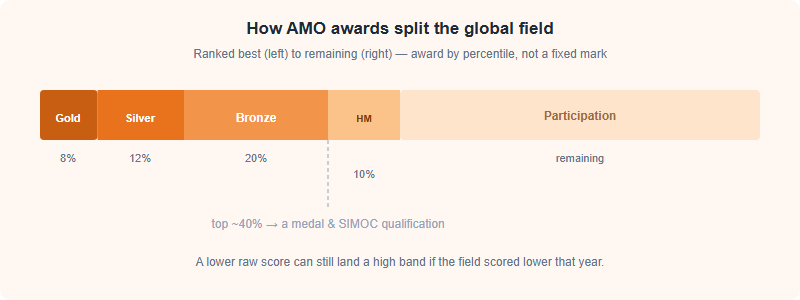
When your American Mathematics Olympiad (AMO) result arrives, the most important thing to understand is that it is a global percentile rank, not a school-style pass mark. Awards are set by where you place against every participant worldwide: Gold (top 8%), Silver (next 12%), Bronze (next 20%) and Honourable Mention (next 10%). A "low" raw score out of 100 can still be a strong rank. AMO is run by SIMCC (Singapore) with Southern Illinois University — it is not the MAA’s AMC.
What the medal tiers actually mean
The award is the headline of your result, and each tier corresponds to a band of the global field. Because the cut is by rank, the same raw score can win different medals in different years depending on how the whole cohort performed. Here are the tiers as published by SIMCC — always confirm the current year's thresholds on the official AMO pages.
| Award | Global rank band | What it signals |
|---|---|---|
| Gold | Top 8% | Top-tier result worldwide; pathway toward SIMOC and possible IJMO selection |
| Silver | Next 12% (top ~20%) | Strong result; qualifies for SIMOC; can be in the IJMO selection pool |
| Bronze | Next 20% (top ~40%) | Solid result; qualifies for SIMOC |
| Honourable Mention | Next 10% (top ~50%) | Recognition above participation; receives a certificate |
| Participation | Remaining | Completed the contest; certificate of participation |
For exactly how the raw marks translate into these bands, see our breakdown of how AMO scoring works. The headline to internalise: a medal reflects your position in a strong global field, which is why it is a more meaningful signal than a bare score.
The other numbers on your result
Beyond the medal, an AMO result and certificate typically carry a few more data points. Exact wording varies by year, so treat this as a guide to what to look for and confirm specifics on the official pages.
- Your award level and certificate. The medal/HM/participation status, usually with a certificate. Medallists and recognised students receive recognition; participation recipients receive a certificate too.
- Your raw score. Marks out of 100 from the three sections. Useful for your own review, but remember the award is set by rank, not this number.
- Rank indicators. AMO communicates results by global ranking. Depending on the year, you may see global and/or national positioning — read it as "where I placed in the field," not "how many I got wrong."
- SIMOC qualification status. Whether your award qualifies you to join SIMOC, the live championship round.
If any of these are unclear on your result, the official SIMCC / AMO pages are the authority — do not infer a benefit or threshold that is not stated there.
What each award unlocks next
AMO is the entry round of a connected ladder, and your award level — not merely taking part — is what opens the next rung. Here is the progression as SIMCC describes it.
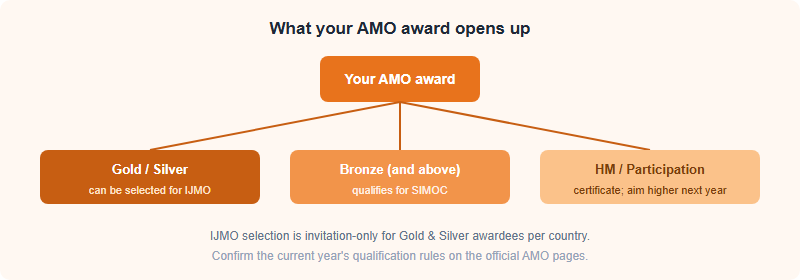
SIMOC is the live championship round that the top ~40% (Gold, Silver and Bronze medallists) qualify to join — it tests both pen-and-paper olympiad problems and interactive team maths games. IJMO, the International Junior Math Olympiad, is the invitation-only international round: per SIMCC, only AMO (and SASMO) Gold and Silver awardees from each country are selected to represent their country. For the full map of how these contests connect, see our overview of what AMO is and where it leads.
Why the same raw score can mean different awards
This is the part that confuses families most, so it is worth a concrete illustration. Because AMO awards are pegged to global rank, an identical raw score can land in different bands depending on the year's cohort and the level. Consider two students who both scored 68/100.
| Student in a tougher year/level | Student in an easier year/level | |
|---|---|---|
| Raw score | 68 / 100 | 68 / 100 |
| Where the field landed | 68 places them near the top of the pack | Many peers scored higher than 68 |
| Resulting band (illustrative) | Could fall in a higher percentile band | Could fall in a lower percentile band |
| Takeaway | The number is identical; the rank is what the award reflects | |
This is exactly why you should not compare your child's raw score to a friend's from a different year or level and conclude anything about ability. It also explains why SIMCC does not publish a fixed "Gold = 90 marks" rule: the cut-offs float with the field. When you read the result, anchor on the award band and any rank indicator, and treat the raw score as private feedback for your own review rather than the headline.
How to talk to your child about the result
Because AMO is percentile-ranked, the framing matters — especially for younger students for whom this may be a first real competition. Three points keep the experience constructive.
A lower raw score is not a weak result. Placing in the top 40% of a strong global field while solving, say, 60 of 100 marks is a genuinely good outcome. Praise the rank and the effort, not the absolute number.
Use the result to plan, not to judge. The most useful next move is to look at which section lost the most marks and aim the next year's preparation there — far more productive than fixating on the medal colour. A Bronze this year with a clear section weakness identified is a strong base for Silver next year.
The award is a milestone, not a verdict. A Participation or Honourable Mention at grade 3 says very little about a student's ceiling; consistent practice and a shrinking error log matter far more over time than any single year's band.
Keep the certificate and the section data. Save the official certificate and a note of the year, level and section scores in one place. A multi-year record — say, Bronze in grade 4, Silver in grade 5 — tells a clearer story of growth than any single result, and the section history is the most useful planning document you have when deciding what to work on next. If your child goes on to SIMOC, that progression becomes part of a genuine competition trajectory rather than a one-off line.
A note on what an AMO result does and doesn't mean
An AMO award is a recognised signal of mathematical ability relative to a global field, and a Gold or Silver in particular reflects a strong placement. But like any single competition, it is one data point — it does not guarantee any academic outcome, and no honest partner would promise that it does. Treat it as evidence of progress and a gateway to harder, more rewarding contests like SIMOC, rather than as a finish line. The real long-term value is the habit the contest builds: regular practice, handling a timed paper, and learning to think through unfamiliar problems.
Frequently asked questions
Is the AMO result a percentile or a raw score?
Awards are set by global percentile rank, not a fixed pass mark: Gold top 8%, Silver next 12%, Bronze next 20%, Honourable Mention next 10%. Your raw score out of 100 is separate. Confirm on amo.simcc.org.
What does an AMO medal qualify my child for?
The top ~40% (Gold, Silver, Bronze) qualify for SIMOC, the live championship round. Per SIMCC, only Gold and Silver awardees per country are selected for IJMO.
Is a low raw score a bad AMO result?
Not necessarily. Because awards are by rank against a strong global field, a modest raw score can still place in a high percentile band and earn a medal. Read the rank, not just the number.
Where do I confirm my AMO award and next steps?
On the official SIMCC / AMO pages, which are the authority on award thresholds, certificates and SIMOC/IJMO qualification for the current year.
This site is operated by Hanlin Education as an authorized AMO registration partner for China. AMO (American Mathematics Olympiad) is run by the Singapore International Math Contests Centre (SIMCC) together with Southern Illinois University (SIU); it is a SIMCC contest from Singapore and is not the AMC run by the MAA in the United States. We are a registration partner, not the organiser. Award tiers, certificates, rank reporting and SIMOC/IJMO qualification rules are set by SIMCC and can change — always confirm current details on the official SIMCC / AMO pages. If you spot an error, we will correct it within 7 working days.