
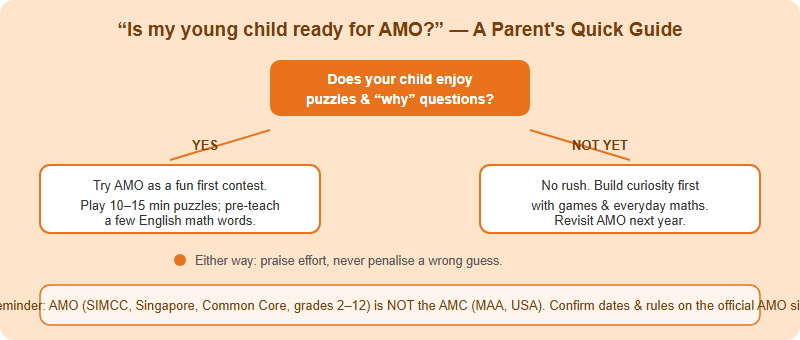
For a child in grades 2 to 4, the American Mathematics Olympiad (AMO) is a gentle, no-penalty puzzle contest — not a high-stakes exam. AMO is run by SIMCC (Singapore) with Southern Illinois University and is based on the US Common Core; it is open from Primary 2 (Grade 2) upward, with a separate, age-appropriate paper for each level. The goal at this age is curiosity, not medals. Importantly, AMO is not the AMC (the high-school contest run by the MAA in the USA).
What an AMO problem actually feels like at grades 2–4
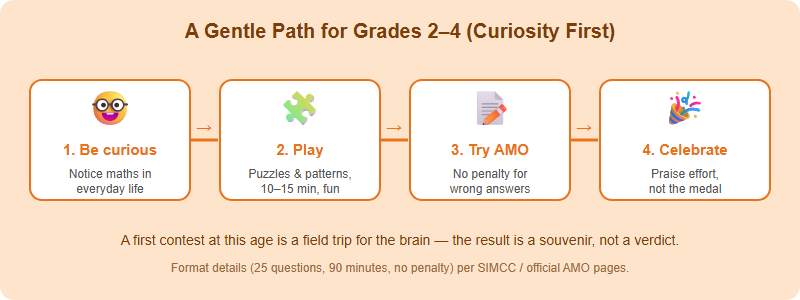
Parents often picture an “olympiad” as a wall of impossible algebra. At the youngest levels, AMO looks nothing like that. Each grade level sits a different, differentiated paper, so a Grade 2 child never opens a Grade 6 paper. The contest is built around 25 questions over 90 minutes, split into multiple-choice and a small number of longer “non-routine” thinking problems, and — this is the part that calms most young children — there is no penalty for a wrong answer. A guess that doesn’t work simply earns zero, never a deduction.
Because the framework follows the US Common Core, the topics are ones a primary child is already meeting in school: counting patterns, place value, simple shapes, money, time, and word problems told as little stories. What makes them “olympiad” questions is the twist — they ask a child to notice a pattern or reason in an unusual order, rather than to do a long calculation. A typical early problem might describe animals on a farm and ask how many legs in total, or show a row of beads and ask which colour comes next. The maths is gentle; the thinking is the point.
If you want the full mechanics of how the paper is structured and scored, our companion explainers cover how AMO grade levels work from Grade 2 to 12 and how AMO scoring and medals work. This article stays focused on the youngest learners.
AMO is NOT the AMC — clearing up the most common mix-up
This is the single most important thing for a parent to understand before signing up. The names look almost identical, but they are two completely different competitions run by different organisations on different continents. Confusing them leads families to enrol a 7-year-old in the wrong contest entirely.
| AMO (this competition) | AMC | |
|---|---|---|
| Full name | American Mathematics Olympiad | American Mathematics Competitions |
| Run by | SIMCC (Singapore) + Southern Illinois University | MAA (Mathematical Association of America), USA |
| Who it's for | Grades 2–12 (Primary 2 onward) — young children welcome | Mainly high-school students (AMC 8 / 10 / 12) |
| Framework | Based on US Common Core | MAA's own olympiad syllabus |
| Leads to | SIMOC and IJMO (Singapore-based international rounds) | AIME → USA(J)MO → IMO |
| Good fit at grade 2–4? | Yes — designed with primary levels | No — built for older students |
So if your child is in grade 2, 3, or 4, AMO is the contest that actually has an age-appropriate paper for them; the AMC does not. Hanlin is an authorized AMO registration partner for China, which means we help families enter AMO through the official SIMCC channel — we are not the organiser, and we are not affiliated with the MAA or the AMC. For the bigger picture of what AMO is and where it sits, see our overview, What Is AMO?
How a young child builds up — without stress
The fastest way to put a 7- or 8-year-old off maths forever is to drill them like a test-taker. At this age, the research-backed and common-sense approach is the same: protect the child’s enjoyment of thinking, and competence follows. Here is what “preparation” should look like for grades 2–4.
- Short and playful. Ten to fifteen minutes of puzzles is plenty for this age. A child who finishes wanting more will come back tomorrow; a child who is drilled for an hour will dread it.
- Patterns and pictures before symbols. Young children reason brilliantly with blocks, drawings, coins, and stories long before they’re fluent with written equations. Let them see the maths.
- Wrong answers are information, not failure. Because AMO itself never penalises a wrong answer, you can mirror that at home: “Interesting — what made you think that?” keeps a child reasoning out loud instead of freezing.
- One past-style paper, untimed, near the contest. A single relaxed run-through of the right grade level — with no clock — lets a child meet the format so the real day feels familiar, not scary.
- Praise the effort and the strategy, not “you’re so smart.” Children praised for effort take on harder problems; children praised for being clever tend to avoid challenges so they don’t lose the label.
Notice what is not on this list: nightly worksheets, speed drills, or comparing your child to others. For a grade 2–4 learner, a first olympiad is best framed as an adventure — “let’s go see some interesting puzzles” — rather than a verdict on ability.
How parents can genuinely help at home
You do not need to be a “maths person” to support a young AMO learner. The most valuable things a parent provides are emotional safety and everyday curiosity, not advanced tutoring. A few concrete habits:
- Make maths a normal part of life. Count stairs, halve a pizza, compare prices at the shop, guess how many minutes until dinner. This builds number sense painlessly.
- Ask “how did you get that?” instead of “is it right?” Reasoning out loud is the whole skill an olympiad rewards. Your job is to be a curious listener.
- Let them be stuck for a moment. Resist jumping in with the answer. Productive struggle — even thirty quiet seconds — is where the learning happens. A gentle “what could you try?” is enough.
- Keep the temperature low on contest day. A good breakfast, a calm “just enjoy the puzzles,” and zero talk of medals beforehand does more for performance than any last-minute cramming.
- Celebrate participation. Finishing a real contest at age 7 or 8 is already brave. Whatever the score, that’s worth an ice cream.
A note on honesty: AMO recognises roughly the top 40% of participants with a medal (Gold for the top tier, then Silver, then Bronze), so many — but not all — young participants come home with something. That’s a feature for this age group, because it rewards showing up and trying. But please confirm the current award structure, scoring, and any rule changes on the official SIMCC / AMO pages before the contest, as details can be updated year to year.
English math vocabulary that helps non-native young learners
AMO is sat in English, and for a Chinese-school child who knows the maths in Chinese, the biggest hurdle is often a word, not a concept. A child who can add perfectly may stall on a question simply because they don’t recognise “altogether” or “how many more.” Pre-teaching a small set of everyday math words removes that barrier. These are not advanced terms — they are the connective words that primary word problems lean on.
| English word/phrase | What it asks the child to do | Plain meaning |
|---|---|---|
| altogether / in total / sum | Add everything up | 一共有多少 |
| how many more / how many fewer | Find the difference (subtract) | 多出/少了多少 |
| each / per / every | Same amount for one group → often multiply | 每一个 |
| share equally / split into | Divide into equal groups | 平均分 |
| left / remaining | What is still there after taking some away | 剩下 |
| double / twice / half | Two times, or one of two equal parts | 倍/一半 |
| odd / even | Numbers that can't / can be paired up | 奇数/偶数 |
| pattern / next | Spot the rule, then continue the sequence | 规律/下一个 |
A friendly way to teach these: spend a week pointing them out in real life. “We have three apples and two more — how many altogether?” After a few days, the words stop being English homework and become part of how the child thinks. That single habit often does more for a young learner’s AMO experience than any extra calculation practice.
Frequently asked questions
Is AMO the same as the American AMC contest?
No. AMO is run by SIMCC (Singapore) with Southern Illinois University for grades 2–12. The AMC is a different, mainly high-school contest run by the MAA in the USA.
Is grade 2 really old enough for a math olympiad?
Yes. AMO offers a separate, age-appropriate paper from Primary 2 (Grade 2) upward, with no penalty for wrong answers — so it suits young, curious beginners.
How should we prepare a young child without stress?
Keep it short and playful: 10–15 minutes of puzzles, patterns with pictures, and one relaxed untimed practice paper. Praise effort, not the medal.
When is AMO and how do we register?
Hanlin can register your child through the official SIMCC channel as an authorized partner. Please confirm the current dates and deadlines on the official AMO / SIMCC pages.
This guide is published by the AMO Club editorial desk, operated by Hanlin Education as an authorized AMO registration partner for China. The American Mathematics Olympiad (AMO) is run by SIMCC (Singapore International Mastery Contest Center) together with Southern Illinois University (SIU); it is based on the US Common Core and is not the AMC run by the MAA in the USA. We are not the organiser. Registration dates, deadlines, scoring, and award details can change year to year — always confirm current information on the official SIMCC / AMO pages before registering. We correct any factual error within 7 working days.