
The American Mathematics Olympiad (AMO) is an international mathematics competition for students in grades 2 through 12, organised by the Singapore International Math Contest Centre (SIMCC) together with Southern Illinois University (SIU). Its questions are framed around the U.S. Common Core standards — but, despite the “American” in its name, AMO is not the same as the AMC. This guide clears up that confusion and explains how AMO actually works for families.
Quick facts (2026)
| What it is | International school math competition, grades 2–12 |
| Organised by | SIMCC (Singapore) + Southern Illinois University (SIU) |
| Question basis | U.S. Common Core mathematics standards |
| Duration | 90 minutes per level |
| Awards | Gold (top 8%), Silver (next 12%), Bronze (next 20%) — top ~40% earn a medal |
| Advances to | SIMOC, and the IJMO (International Junior Math Olympiad) track |
| Official source | amo.simcc.org |
Who actually runs AMO? (And why the name confuses people)
This is the single most common question we get from parents, so let’s answer it plainly. AMO is run by SIMCC, a Singapore-based contest organiser, in partnership with Southern Illinois University. The “American” refers to the U.S. Common Core framework the questions are built on — not to a U.S. governing body. It is a well-established international contest popular across Asia, with a clear advancement path to SIMCC’s regional olympiads. Knowing this upfront saves a lot of confusion later.
AMO vs AMC: the difference every parent should know
Because the abbreviations look alike, families often assume AMO and the AMC (American Mathematics Competitions) are the same event. They are run by different organisations, for different ages, with different goals.
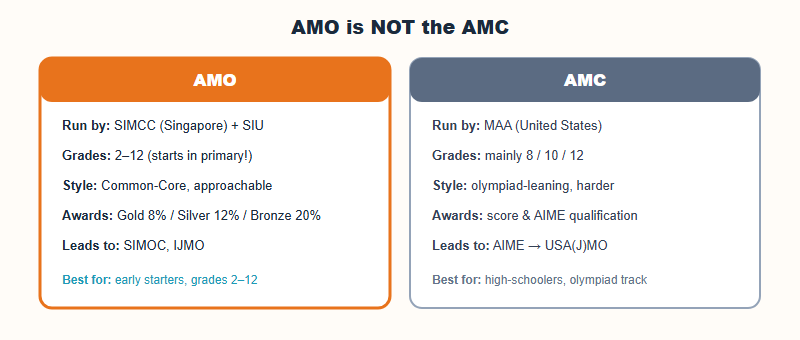
The practical takeaway: if your child is in primary or middle school and you want an encouraging, well-structured first competition, AMO is built for exactly that age. The AMC becomes relevant later, in high school, for students aiming at the U.S. olympiad track. They are complementary, not interchangeable.
Grade levels, format and the medal system
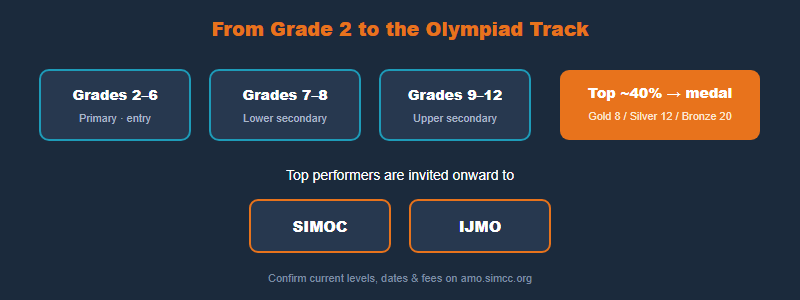
AMO runs one 90-minute paper per level, grouped by grade — see our grade-by-grade breakdown. Crucially, awards are ranked by percentile, not a fixed pass mark — the top ~40% of participants earn a medal (Gold 8%, Silver 12%, Bronze 20%), and there is no penalty for wrong answers (see how scoring works). That percentile design is what makes AMO encouraging for younger students: the goal is your position in a strong global field, not a perfect score.
How young students prepare — and how to register
For grades 2–8, preparation should stay light and consistent rather than intense. A workable rhythm is one short timed set a week from official-style past problems, plus a quick review of the English maths vocabulary that non-native speakers most often trip on — words like “remainder”, “product” and “perimeter” decide marks as much as the arithmetic does. Because AMO is percentile-ranked with no penalty for wrong answers, a young student is rewarded for attempting every question, so the habit of trying matters more than drilling for speed.
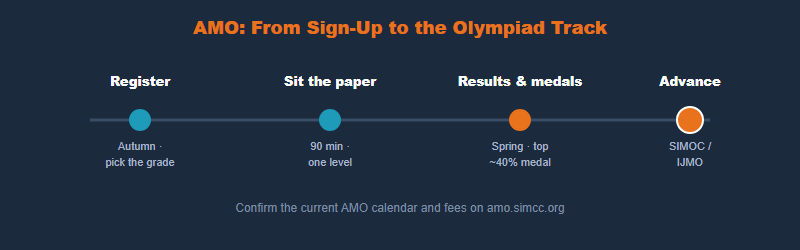
Registration is where we help directly. As an authorized registration partner, we place each child at the right grade level, explain the official timeline, and handle the sign-up with SIMCC the proper way — so families avoid the friction of entering an international contest from China. And if a high-school contest like the AMC would actually fit your child better, we will tell you honestly rather than just sign you up.
Is AMO worth it — and who is it for?
AMO is at its best as a first real competition for grades 2–8: low-pressure, percentile-ranked, no penalty for guessing, with a clear path to harder contests for those who catch the bug. For older students it can sit alongside other contests rather than replace them. As with any competition, the value is in the habit it builds — regular practice, handling a timed paper, and learning to think rather than to memorise. We help families decide whether it fits, which grade to enter, and how to register the official way.
Three things parents often get wrong about AMO
A few misunderstandings come up again and again, and clearing them up keeps the experience positive for a young child. First, a lower raw score is not a weak result. Because AMO is ranked by percentile against a strong global field, what matters is your child’s position, not the absolute number of questions solved — a “low” raw score can still place in the top tier. Second, speed is not everything. There is no bonus for finishing early, and the no-penalty design rewards careful, complete attempts; accuracy and clear reasoning beat rushing. Third, AMO does not replace the AMC later on. Think of AMO as the encouraging on-ramp in primary and middle school that makes the harder high-school contests feel approachable when the time comes — they sit on the same journey, at different ages.
Frequently asked questions
Is AMO the same as the AMC?
No. AMO is run by SIMCC (Singapore) with SIU, for grades 2–12. The US AMC is run by the MAA in the United States, mainly for high-schoolers on the AIME/USA(J)MO olympiad track; the Australian AMC (AMT) is yet another competition. Different organisers, ages and goals.
Is AMO an official American competition?
It uses the U.S. Common Core framework and partners with Southern Illinois University, but it is organised by Singapore-based SIMCC. It is an international contest, not a U.S. national body’s exam.
What grades can enter AMO?
Grades 2 through 12, grouped into levels. It is one of the few math olympiads that starts as early as grade 2.
How do medals work?
By percentile, not a fixed mark: roughly the top 40% earn a medal — Gold (top 8%), Silver (next 12%), Bronze (next 20%). There is no penalty for wrong answers.
AMO is organised by SIMCC and Southern Illinois University. This site is operated by Hanlin Education as an authorized registration partner for China-based international-school families — we explain the contest and help you register the official way. Figures reflect publicly available information and may change by season; always confirm on amo.simcc.org.