
The American Mathematics Olympiad (AMO) does not publish a fixed chapter-by-chapter syllabus, but its questions consistently cluster into five recurring topic strands — number theory, algebra, geometry, combinatorics/counting, and logic/problem-solving — that deepen as a student moves up the grades. This guide maps those strands to each division so a family can see what to actually study, rather than drilling at random. AMO is run by SIMCC in Singapore with Southern Illinois University; it is not the MAA’s AMC in the United States.
Why AMO is a “topic map”, not a textbook syllabus
Parents often ask for “the AMO syllabus” the way they would ask for a school exam scope. AMO works differently. Because awards are ranked by percentile rather than against a fixed pass mark (the top ~40% earn a medal — Gold 8%, Silver 12%, Bronze 20%), the paper is built to spread students out, not to test a closed list of facts. So instead of a syllabus you can tick off, what you get is a set of recurring problem types that reward flexible thinking on familiar topics.
That is good news for preparation: you can study the strands below with confidence that they appear year after year, while remembering that the exact questions, difficulty, and weighting are set by SIMCC and can change. Always confirm the current year’s format on the official AMO pages. For the bigger picture first, see our explainer on what AMO is and how the grade levels run from Grade 2 to Grade 12.
The five topic strands AMO returns to every year
Across all divisions, AMO questions tend to draw from the same five families. The table shows what each strand looks like and roughly how its emphasis shifts as the grade rises. Treat the weighting as a study guide, not an official blueprint — SIMCC does not publish a per-strand mark split.
| Strand | Typical question flavour | Where it gets harder by Senior |
|---|---|---|
| Number theory | Factors, multiples, remainders, divisibility, digit puzzles | Modular arithmetic, number bases, properties of primes |
| Algebra & patterns | Sequences, “find the rule”, word problems, simple equations | Manipulating expressions, simultaneous equations, functions |
| Geometry & measurement | Area, perimeter, angles, shapes, simple spatial reasoning | Similar triangles, circle facts, coordinate & 3-D reasoning |
| Counting & combinatorics | Systematic listing, simple arrangements, “how many ways” | Permutations, combinations, pigeonhole, casework |
| Logic & problem-solving | Working backwards, true/false reasoning, puzzles | Invariants, extremal arguments, multi-step proofs of an answer |
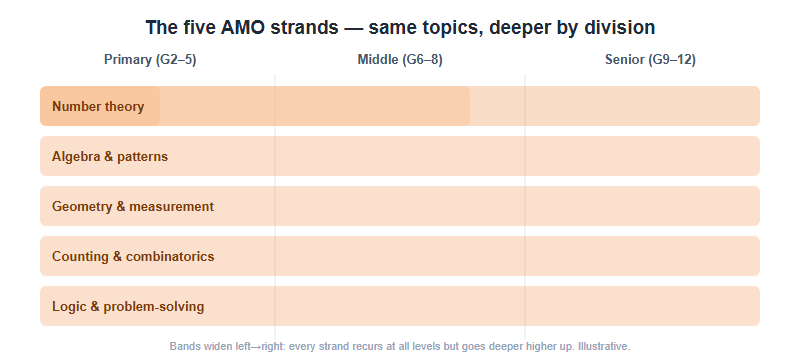
Primary band (Grades 2-5): build number sense and careful reading
In the Primary papers, the maths content sits close to a strong school curriculum, but the questions are dressed up as puzzles. The differentiator is rarely advanced content — it is whether a young student can read a wordy English problem accurately and stay systematic. Focus here:
- Number theory: factors and multiples, odd/even, simple remainders, place value and digit puzzles.
- Algebra & patterns: continuing and describing number/shape patterns, simple “missing number” equations, age and money word problems.
- Geometry: perimeter and area of rectangles, counting shapes, basic angles, and spatial “how many cubes” questions.
- Counting: listing possibilities in order, simple “how many ways” with small numbers.
- Logic: working backwards from an answer, simple true/false deductions.
For Grades 2-5 specifically, our gentle introduction for young learners shows how to keep this stage light and confidence-building rather than pressured.
Middle band (Grades 6-8): the strands start to interlock
The Middle papers are where AMO stops feeling like enriched school maths and starts feeling like contest maths. Questions begin to combine two strands at once — a counting problem that needs a divisibility idea, or a geometry problem that needs an algebraic step. Priorities:
- Number theory: divisibility rules, factor counting, LCM/HCF in disguise, basic modular thinking (“what is the remainder when…”).
- Algebra: forming and solving equations from words, manipulating simple expressions, arithmetic sequences and their sums.
- Geometry: angle chasing, area by decomposition, properties of triangles and quadrilaterals, introductory coordinate geometry.
- Combinatorics: systematic casework, simple permutations and combinations, the start of the pigeonhole idea.
- Logic: invariants in simple games, “find the largest/smallest” extremal questions.
Senior band (Grades 9-12): depth, proof-style reasoning, and speed
By the Senior band, the same five strands are pushed to a level where a correct final answer usually requires a short chain of non-obvious steps. The content overlaps with school algebra, geometry and pre-calculus, but the method is olympiad-style. Emphasis shifts toward:
- Number theory: modular arithmetic, properties of primes, Diophantine-style answers, number bases.
- Algebra: functional relationships, inequalities, polynomial and exponent manipulation, clever substitutions.
- Geometry: similar triangles, circle theorems, coordinate methods, and 3-D reasoning.
- Combinatorics: permutations and combinations fluently, pigeonhole arguments, structured casework, counting with symmetry.
- Logic: invariants, extremal principles, and constructing the reasoning that pins down a unique answer.
This is also the level where the contest most clearly signals readiness for harder programmes and where the harder questions tend to separate medal-winners — confirm the current paper structure and any per-question weighting on the official AMO pages (see how AMO scoring works).
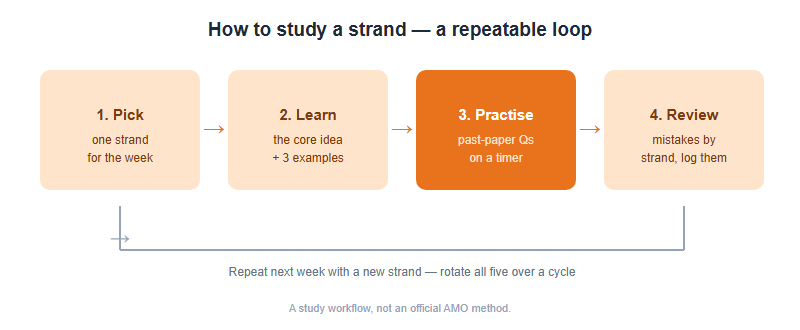
Turning the map into a study plan
A topic map is only useful if it changes what a student does on Saturday morning. Three practical moves:
1. Diagnose before you drill. Sit one full past paper untimed and sort every mistake into one of the five strands. Most students discover two strands carry the majority of their lost marks. That is your starting point — not “do more questions” in general.
2. Study one strand per week, in your grade’s depth. Use the division lists above so a Grade 7 student practises Middle-level combinatorics, not Senior-level. Going too hard too early is a common reason a capable child loses confidence.
3. Build the English vocabulary alongside the maths. AMO is an English-language paper, and a single misread term — “remainder”, “consecutive”, “at most”, “product” — can sink an otherwise-correct solution. International-school students benefit from a deliberate maths-vocabulary list. For a structured way to practise on real questions, see our scoring guide and pair it with timed past papers.
The strand most students under-train — and why
If you look at where Grade 6-12 students most often lose marks, two strands stand out: counting/combinatorics and number theory. Both reward a way of thinking that school maths rarely drills. School tends to teach procedures with one clear method; AMO’s harder counting and number-theory questions ask you to organise a search — to list cases without missing or double-counting, or to spot a divisibility structure hidden inside a word problem. That is a skill, and it grows with deliberate practice rather than with more arithmetic.
Geometry is the opposite trap: students often feel comfortable because they recognise the shapes, then lose marks because an AMO geometry question hides a second step — an angle fact you must combine with an area decomposition, say. The lesson from the strand map is to train the combinations, not just the isolated topics. A student who can do a clean permutation and a clean divisibility check separately still needs practice on the questions that demand both at once, which is exactly what the Middle and Senior papers tend to ask.
A simple way to act on this: when you review a past paper, do not just mark right or wrong. Tag each missed question with the one or two strands it drew on, and look for the pattern. Most students find their losses concentrate in two strands — and that, not a generic “study harder”, is the map that tells you where the next ten hours of practice should go.
A quick note on what AMO does not test
It helps to know the boundaries. AMO is an answer-based contest rather than a proof-writing one, so students are not asked to write out formal multi-page proofs the way they might in a national olympiad’s later rounds. though writing your method on paper is still the best way to avoid slips. The Primary/Middle/Senior bands above are our study grouping; AMO's official grade/division structure, question format and marking are set by SIMCC — confirm the exact bands and format for your level on the official AMO pages. And because AMO is built by SIMCC for an international field across Grades 2-12, it does not assume the specific curriculum of any one country. That is precisely why it travels well as a benchmark — and why it is a different instrument from the AMC, which the MAA designs mainly for US high-schoolers.
Frequently asked questions
Does AMO publish an official syllabus?
No fixed chapter syllabus is published. Questions recur across five strands — number theory, algebra, geometry, combinatorics and logic — at depths that scale by grade. Confirm current details on the official AMO pages.
Which topics matter most for AMO?
All five strands appear, but number theory and combinatorics often carry the trickiest, medal-deciding questions. Diagnose your own weak strands first rather than assuming.
Do AMO topics change between Grade 2 and Grade 12?
The topic families stay the same; the depth rises. A Primary student meets simple remainders; a Senior student meets modular arithmetic. Study at your current grade’s level.
Is AMO the same content as the AMC?
No. AMO is a SIMCC (Singapore) contest for Grades 2-12; the AMC is run by the MAA in the US, mainly for high-schoolers. Different organisers, ages and design.
This site is operated by Hanlin Education as an authorized AMO registration partner for China. AMO (American Mathematics Olympiad) is run by the Singapore International Math Contests Centre (SIMCC) together with Southern Illinois University (SIU); it is a SIMCC contest from Singapore and is not the AMC run by the MAA in the United States. We are a registration partner, not the organiser. Topic coverage, paper format and award thresholds are set by SIMCC and can change — always confirm current details on the official SIMCC / AMO pages before registering. If you spot an error, we will correct it within 7 working days.