
For the American Mathematics Olympiad (AMO), the most useful preparation a student can do is work real papers at their own grade level — not race ahead into material built for older children. The trouble is that papers are scattered and bare question sheets without solutions teach a young solver very little. So we did the work: we have collected AMO past and practice papers, sorted them by grade level, and added worked solutions for many of them — and we give the pack to you free. (Worked-solution coverage varies — our tutors are adding more over time, so message us for the current set and which levels are covered.) Here is what is inside, how AMO is structured, and a simple method that helps even younger students learn from every paper.
📥 Get the free AMO practice pack
AMO past and practice papers sorted by grade level, with worked solutions for many of them (coverage varies), plus topic notes. Scan the WeChat QR code on this page — we'll send the pack free and point you to the right level for your child's grade.
What's in the pack
A pile of papers is not a plan. The pack pairs the papers with worked solutions and a level-by-level order, so practice time goes into solving rather than searching:
| In the pack | What you get |
|---|---|
| Papers by grade level | Past and practice papers sorted across the AMO grade range (2–12), so a child works at the right level |
| Worked solutions | Step-by-step solutions for many papers — written to teach the method, not just give the answer (coverage varies by level) |
| Topic notes | Short, friendly notes on the recurring ideas the papers test, in English suitable for younger solvers |
| English maths vocabulary | A glossary of the English maths terms that trip up international students on a US-style paper |
How AMO is structured — and how it differs from the AMC
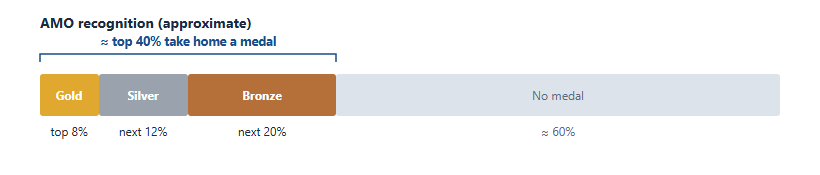
AMO is run by SIMCC (Singapore) with Southern Illinois University, is based on the US Common Core, and spans Grades 2 to 12 — so there is a level for primary-age children, which is unusual among serious maths contests. Recognition is generous: roughly the top 8% earn Gold, the next 12% Silver and the next 20% Bronze, so about the top 40% of participants take home a medal, and strong scorers can progress to SIMOC and IJMO.
One thing to be clear about for parents: AMO is not the AMC. The AMO is the Singapore-run, Grades 2–12 contest described here. The American AMC (AMC 8/10/12) is a different competition, run by the MAA in the United States, mainly for secondary students on the path toward the AIME and USAMO. They sound alike but are separate contests with different organisers and age ranges — the pack is for AMO.
How to use the papers (a method that works for younger solvers)
Having the papers is the easy part. What turns them into progress is how a child works them. The most common mistake is reading a question, checking the answer, and moving on — that builds recognition, not skill. Use this four-step loop on each problem instead:
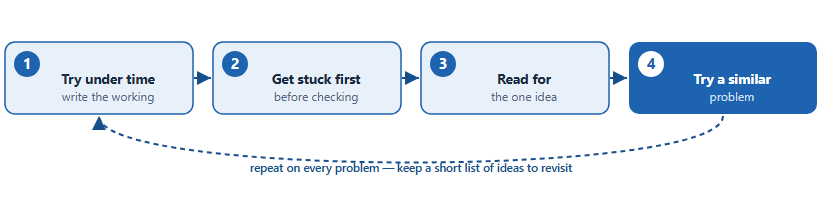
- Try it under time. Sit a paper to the clock and write the working down. Getting the habit of writing out steps matters more than speed at this stage.
- Get stuck before checking. The learning happens in the stuck moment. Give a hard question a few minutes of real effort before opening the solution.
- Read for the one idea. Don't copy the solution line by line — find the single idea that was missing (a pattern, a diagram, a way to count) and say it out loud.
- Try a similar problem. Do another question of the same kind straight away. If it clicks, the idea has stuck; if not, it just looked familiar.
Keep a short list of the ideas a child keeps missing — that list, not the number of papers done, is the real measure of progress. Choosing the right level and giving gentle feedback is where a tutor helps most over solo practice; ask us when you collect the pack. AMO registration also runs through us as an authorised partner, so we can sort papers and entry together.
Ready to start? Get the pack free.
Scan the WeChat QR code on this page for AMO past and practice papers by level, worked solutions for many of them, and topic notes — free. Tell us your child's grade and we'll set the right starting level.
Frequently asked questions
How do I get the AMO practice pack?
Scan the WeChat QR code on this page. We'll send the papers by grade level, worked solutions and topic notes, free of charge.
Do all the papers come with solutions?
No. Many of them come with full worked solutions, but coverage varies by level and not every paper has one yet — our tutors are adding more over time. We'll tell you exactly what is covered when you request the pack.
My child is in primary school — is AMO suitable?
Yes. AMO runs from Grade 2, so there is a level pitched for primary-age children. The pack lets you start at the right grade rather than something built for older students.
Is AMO the same as the AMC?
No. AMO is run by SIMCC in Singapore for Grades 2–12. The AMC is run by the MAA in the United States, mainly for secondary students. Different organisers, ages and goals.
This site is operated by Hanlin Education, an authorised AMO registration partner; the American Mathematics Olympiad is organised by SIMCC with Southern Illinois University. The worked solutions in the pack are our tutors' own work, written to help students learn. Levels, recognition bands and progression can change each year — confirm current details through the official AMO channels.